Voiding the Sacred
Nearly a century ago a man came to the Central American forests with an obsession similar to the Quetzal watchers and photographers of today, but with a vastly different purpose. In 1937, the American explorer Victor Wolfgang von Hagen and his wife Christine, sponsored by the Bronx Zoo, the Zoological Society of London and the Museum of the American Indian, arrived at the port of Trujillo in Honduras with an audacious quest : to be the first person to photograph the Resplendent Quetzal and to capture the bird alive and transport specimens back to the United States and England. The adventures, as chronicled in his book 'The Jungle in the Clouds' was not the comfortable, guided affair that we experience today, but was greatly facilitated by the infrastructure already in place with the presence of the United Fruit Company (known today as Chiquita).
Despite reaching the highlands where the Quetzal lives, the men hired to guide von Hagen were a reticent lot. They spoke of the Sisimiki, a malevolent forest creature whose wrath might be incurred by disturbing the Quetzal. Today we understand that it was a narrative rooted in a deep, instinctual understanding of the forest's sanctity, a framework for the respect that the wilderness demands. However, for Von Hagen, a man of science and singular ambition, these fears were unfounded and by cajoling and paying a fee that his guides could not refuse, he found access into the Quetzal's domain.
The Quetzal Feather
For centuries, the Aztecs had sought the Quetzal's tail feathers—the iridescent, two-feet long streamers that were more valuable than gold. Their use was the exclusive privilege of emperors and high priests; for a commoner to possess one was a capital offense. To kill the bird was to kill a god so the bird was trapped or shot with a blowgun, its magnificent tail coverts were plucked, and it was released.
But how many were captured? How many never truly recovered from the shock of the encounter? The volume of feathers depicted in ancient codices and on stone carvings speaks to an industry of acquisition. One can only imagine the legions of trappers, the intricate networks that funneled these living emeralds from the cloud forests to the imperial heart of Tenochtitlan. (reference : Birds of a Feather: Exploring the Acquisition of Resplendent Quetzal Tail Coverts in Pre-Columbian Mesoamerica)
Today's Quetzal face a different set of challenges. While the birds are not being trapped for their feathers, their evergreen cloud forests are shrinking and fragmenting. There are only a handful spots in Central America where the populations can be considered stable, that is populations of over a hundred nesting pairs, enough pairs to allow for long-term survivability. (reference: Impacts of the loss of neotropical highland forests on the species distribution: a case study using resplendent quetzal an endangered bird species).
This is where lodges that cater to birding and farmers that own the cloud forest environ join hands to protect this bird and its habitat for the future.
The Cabécar
The indigenous Bribri and Cabécar people of Costa Rica have their own stories, their own understanding of the world that contains the Kabek (the word given by the Cabécar to the Respendent Quetzal). Theirs is not a world of scientific classification but one of deep, interwoven meaning. As the anthropologist Uri Salas Díaz explains, their myths are not mere stories, but a complex body of knowledge about the environment, encoded in narrative. The origin of the sea, the rivers, the lagoons—it all begins with the cutting of a great, mythical Tree. The Woodcutters who fell this tree are malevolent figures, yet they are also the bearers of new technology, of the metal axes that replaced the stone ones.
In this myth, there is a profound moral lesson: the power to shape the world comes with a heavy responsibility, and its misuse leads to exile and ruin.
The Hide
We were roused from our post lunch nap next to a crackling fire by a gentle “Señor." We had signed up for a Quetzal nest tour organized by the Paraiso Quetzal lodge. This had been a recommendation from our guide in Esquipulas after he had learned that we were traveling to the Savegre valley for a few days and that we had not researched the breeding season of the Quetzal.
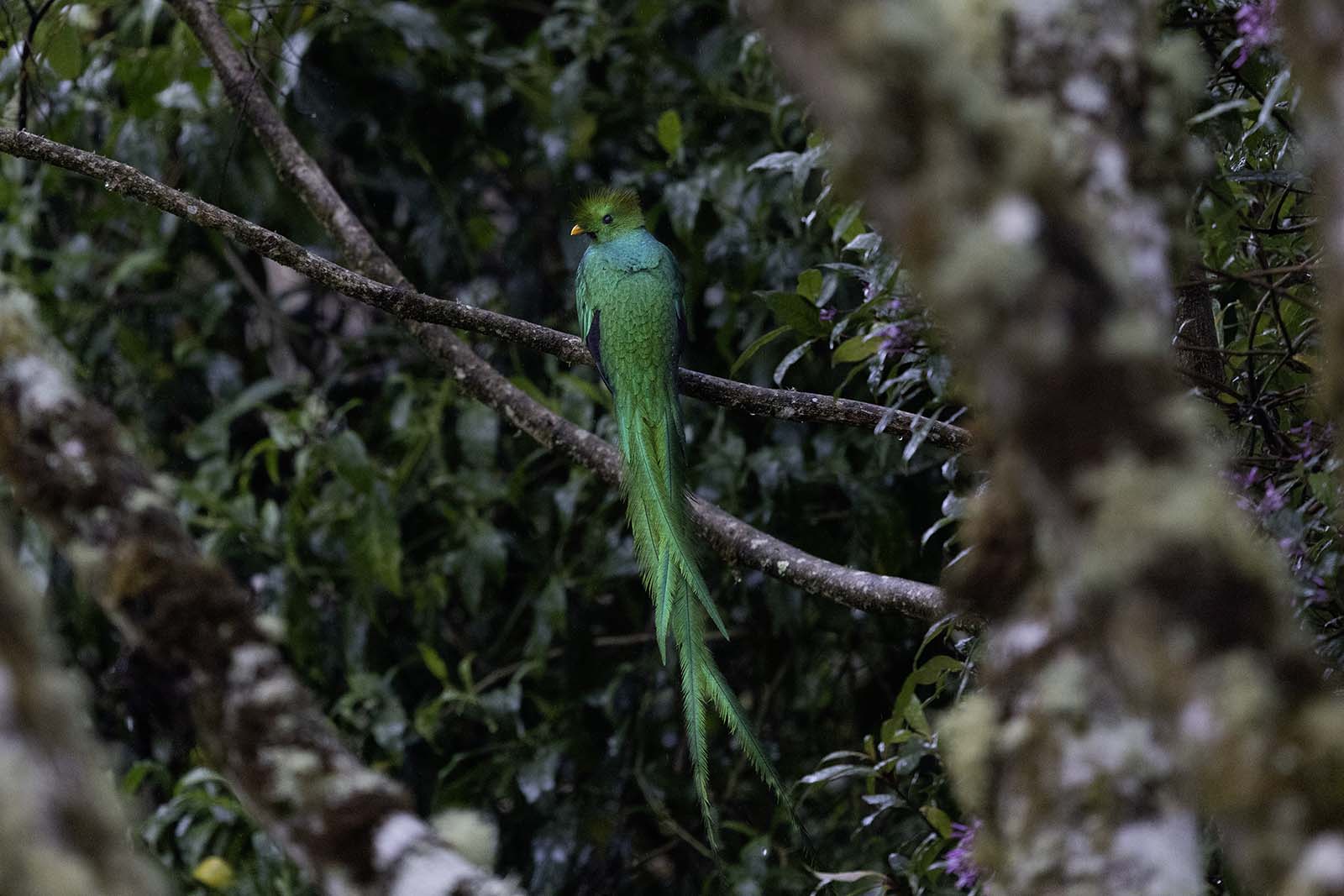
That we had already, just that morning, witnessed the singular spectacle of a male Resplendent Quetzal in the wild ( my photo story : Emerald Streamers in the Cloud Forest) - made this next outing feel like a bonus feature.
We followed the lodge's 4x4 a couple of miles north before it hooked sharply into a narrow descending road and then a dirt road to a small clearing. Here stood a clutch of shacks painted in the bright colors of the local flora. From there it was a few steps to the hide and I was surprised to see that there were already several photographers assembled, a congregation of long lenses and tripods and camping chairs. Every camera was aimed at a dead, decapitated tree trunk some thirty feet away. The tree, the nest-hole and its assembly was man-made.
The stage was a curious blend of the wild and the curated. The nesting tree was situated between the shacks and a steep, densely vegetated hillside. Before the hill rose there was a long branch artfully adorned with bromeliads that I later learned was occasionally used a perch by the Quetzals and was there for set design. There were two viewing platforms, one had a couch against a wall and simple stools and provided a good view of the hillside and the perch but an angled view of the nesting tree. The other, where most of the photographers had gathered had a perpendicular view to the nesting tree and would be perfect if the Quetzal took a linear flight path - aka the 'money shot'.
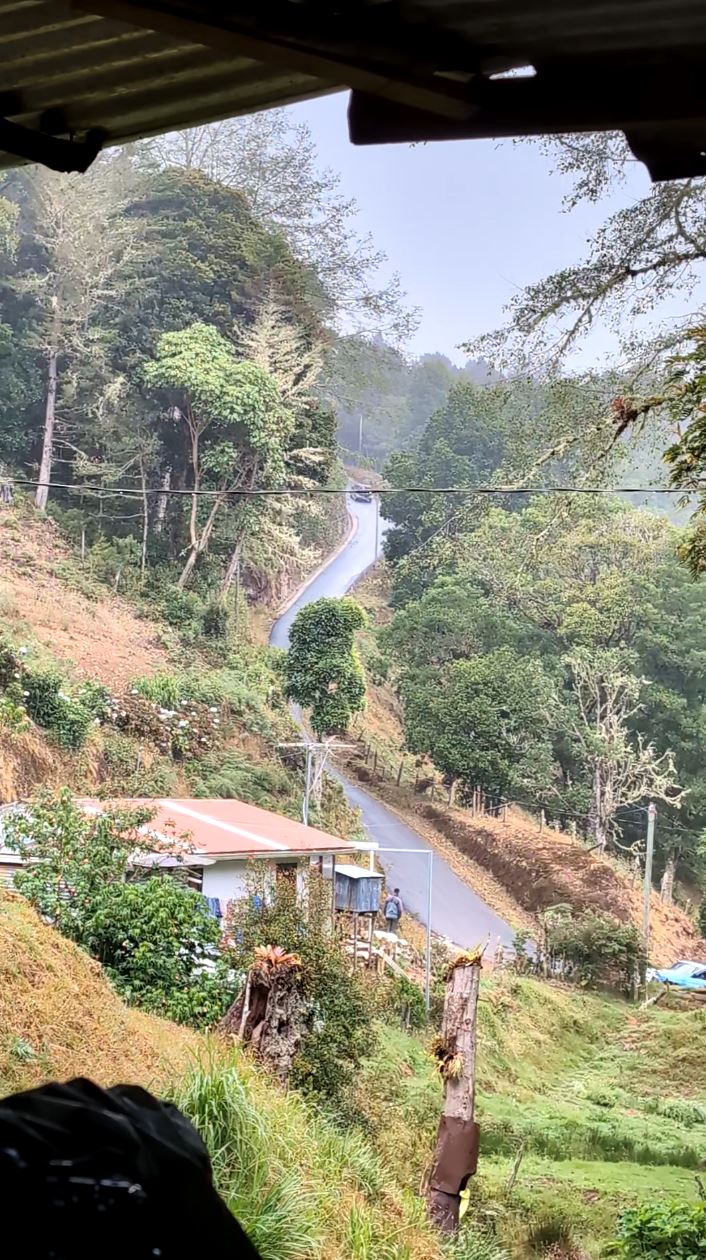
 The setup as seen from the viewing platform
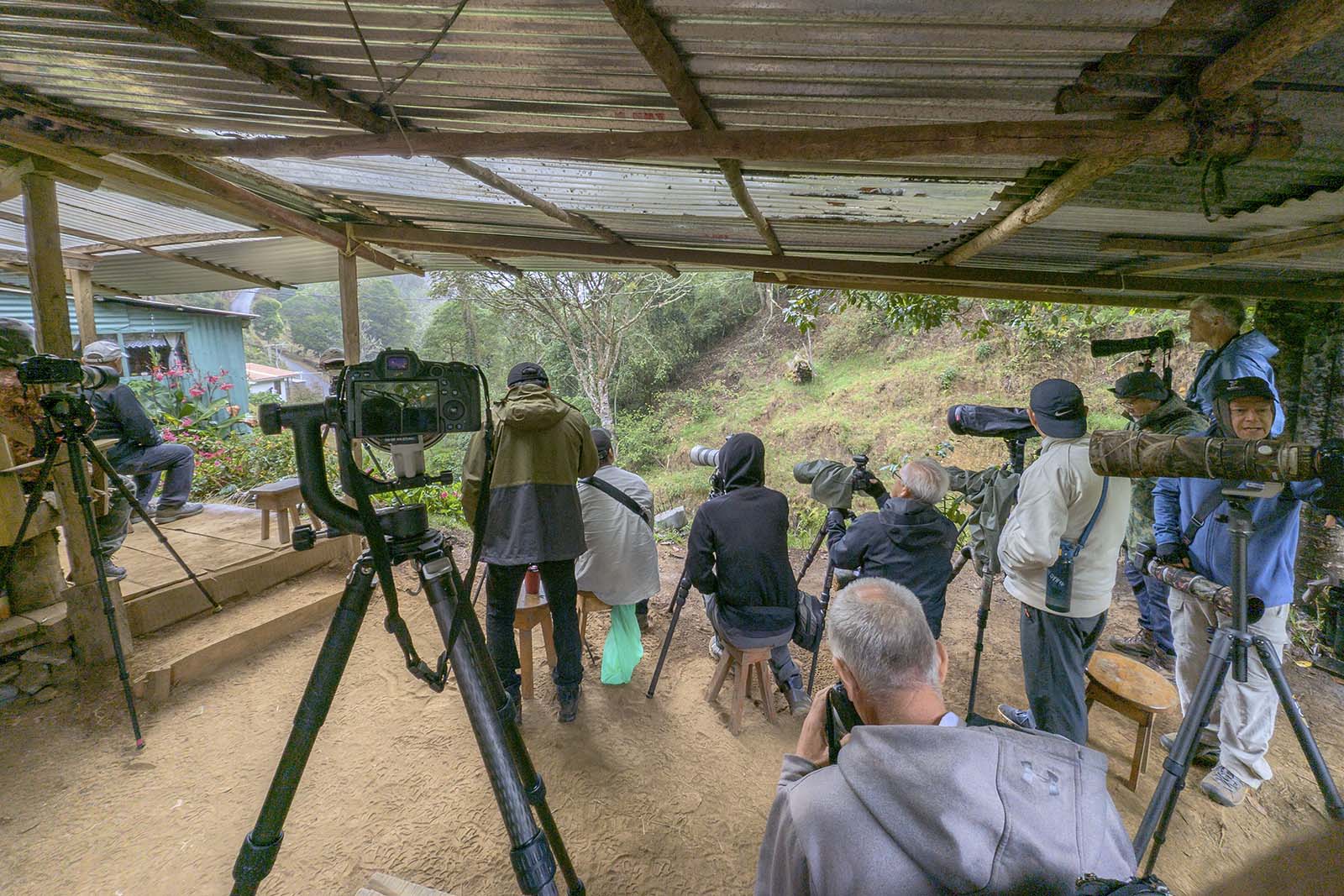 My initial vantage point wasn't the greatest.
Not seen in this photo is the nesting tree or the staged perch. The steep hillside to the right is where the Quetzals would
perch after leaving the nest.
My initial vantage point wasn't the greatest.
Not seen in this photo is the nesting tree or the staged perch. The steep hillside to the right is where the Quetzals would
perch after leaving the nest.
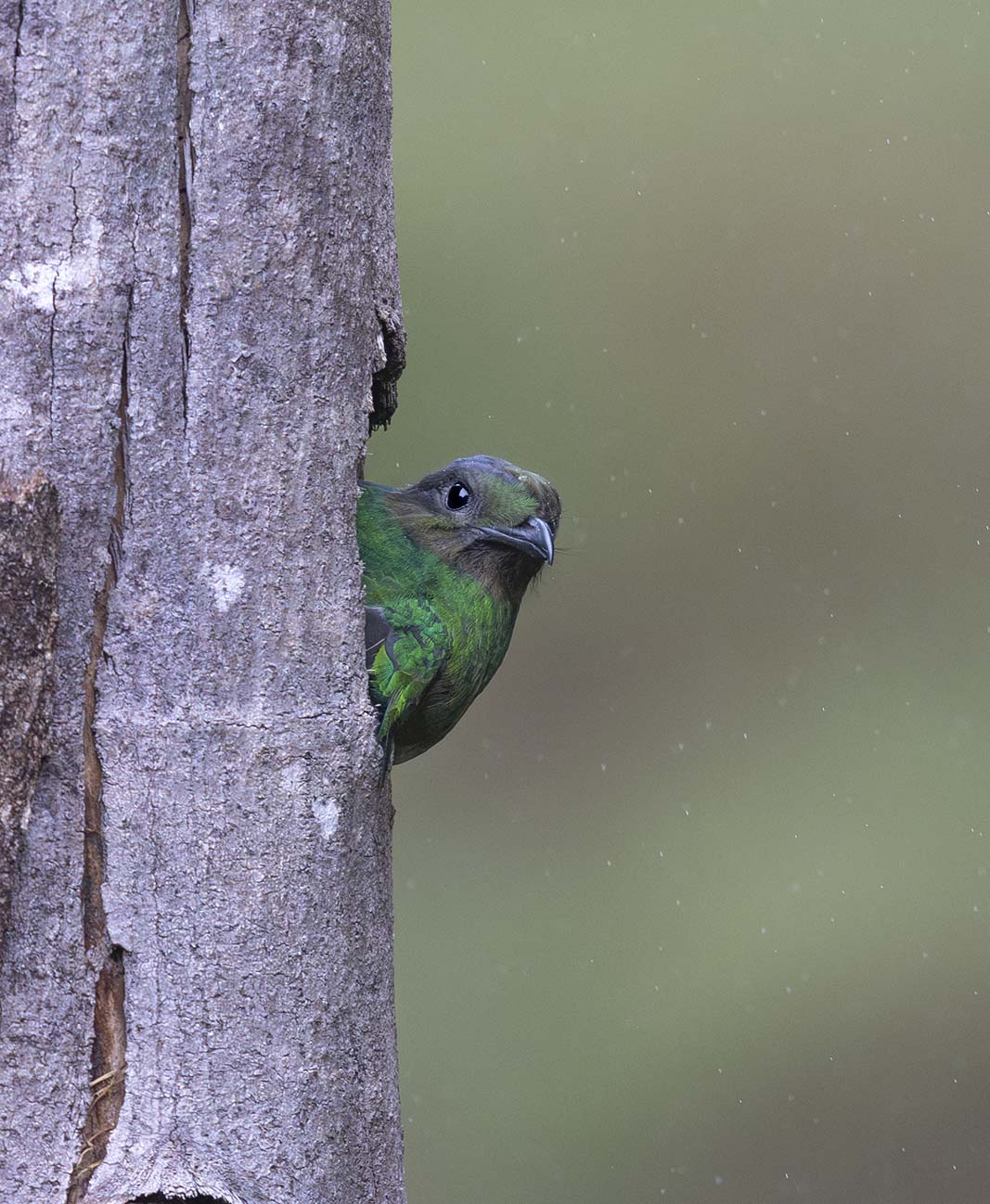
My brother took the former platform and got comfortable on a stool with his camera and binos. I stood behind a row of photographers who had taken first dibs on the platform placement and right away I could see there was a bit of an issue. Even with my tripod elevated, I had a narrow view of the nesting tree framed by the backs and shoulders of the photographers in front of me. But there is no time to change positions anymore as a small cry goes out and the female Quetzal is seen, poking her head from the hole (photos).
 The female Quetzal surveys her surroundings,
a prelude to her nest departure.
The female Quetzal surveys her surroundings,
a prelude to her nest departure.
Cameras are at the ready, fingers are lightly resting on the shutter button. The female continued to survey the space for a good bit of time, but it was perhaps the arrival of what looked like an immature Flame-Colored Tanager that prompted her sudden launch out of the nest, a streak of emerald and white and in a moment she had disappeared into the hillside. I played back my camera feed and saw that after the capturing the initial few feet of emergence from the nesting hole to her first wingstroke, the rest of the photos were completely eclipsed by the photographer in front for me.
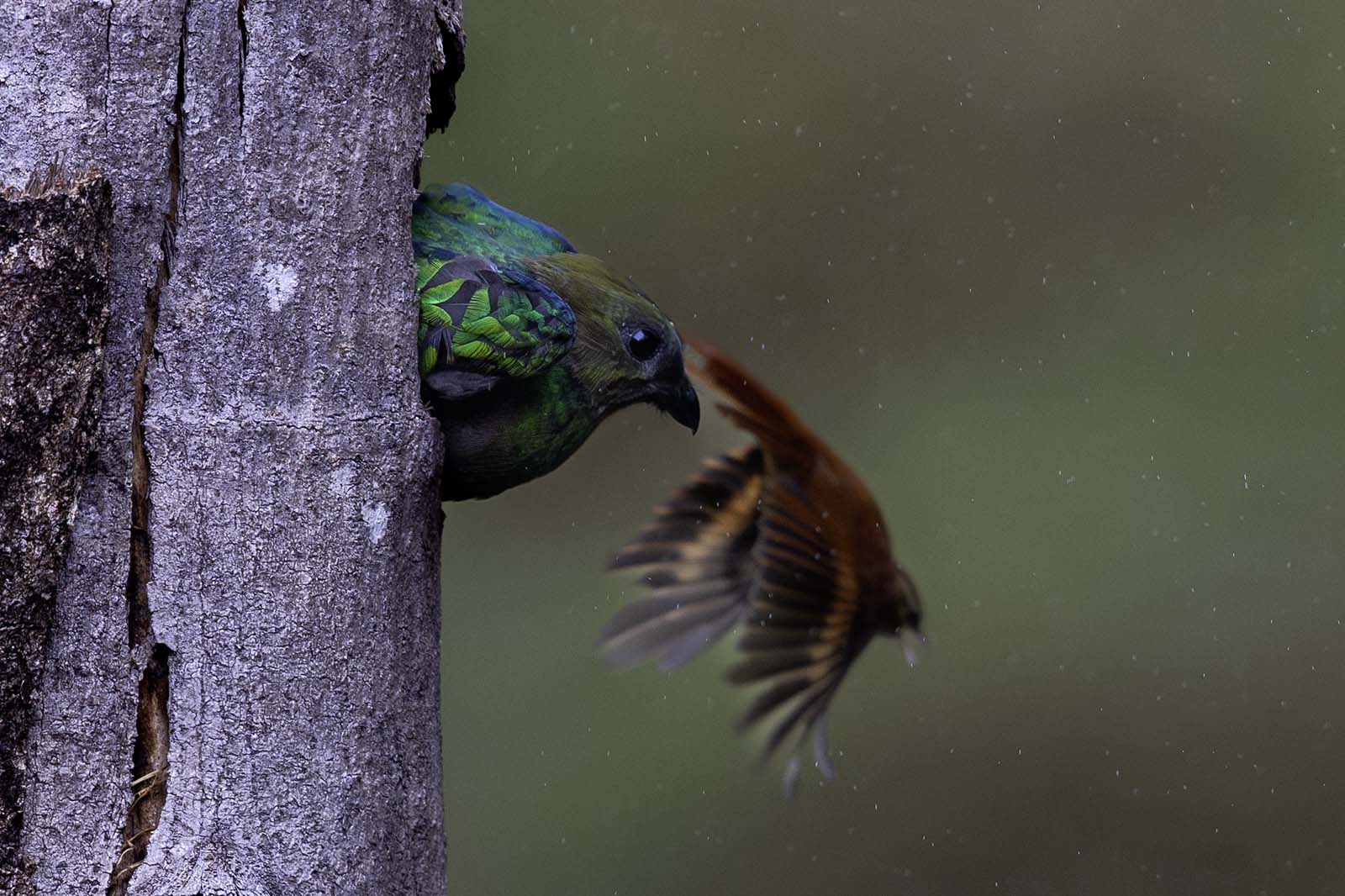 A diving bird (I think it's an
immature Flame-colored Tanager) might have spooked the female Quetzal.
A diving bird (I think it's an
immature Flame-colored Tanager) might have spooked the female Quetzal.
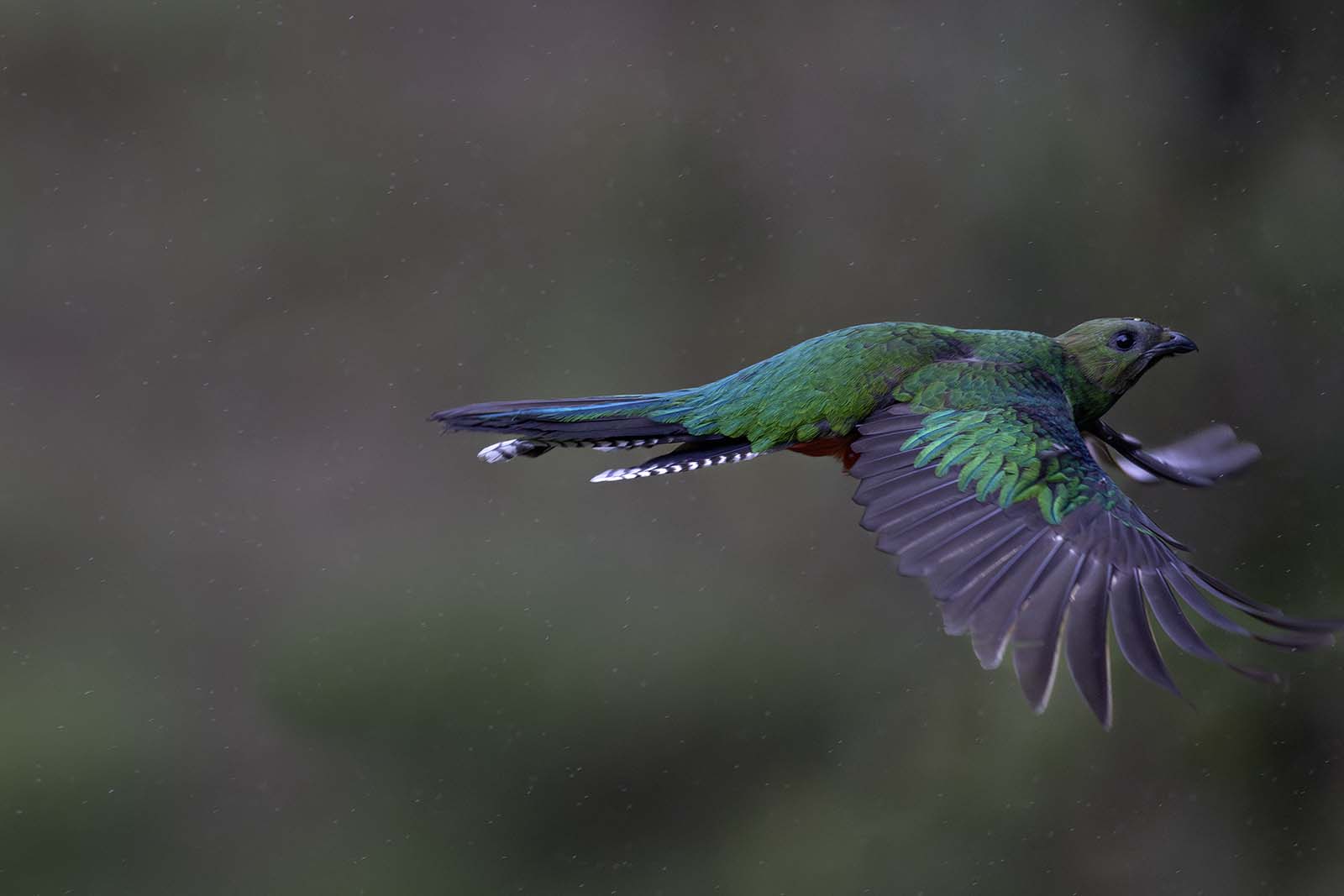 .. and off she goes.
A bit frustrated with the outcome, I changed my vantage point and moved to the outer edge of the platform and from here I had an unobstructed view of the hillside. A fine drizzle had begun to fall and small rivulets of rainwater cut paths through the red dirt, tracing their way to the ravine below. From here, I could see the female, perched high on a branch, looking down our assembly.
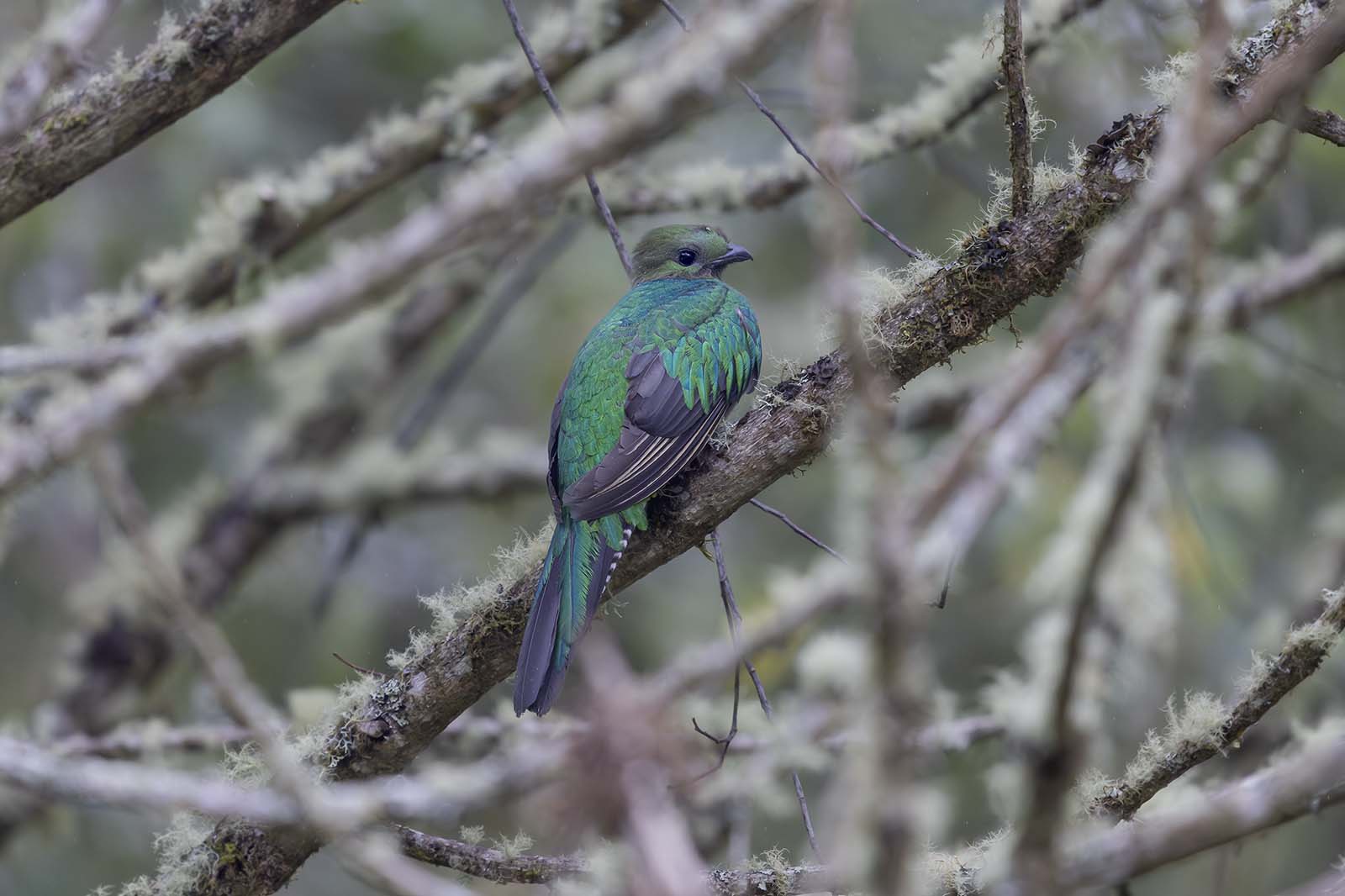 The female, perched high up on the hillside
but still within our view.
The female, perched high up on the hillside
but still within our view.
Minutes roll by as we wait for something to happen. You cannot leave your post, because the moment you do is precisely when the universe chooses to act. My attention drifts to the surroundings. I start talking to a photographer next to me : what birds have you enjoyed photographing on this trip?, how is your new zoom lens working out?
Another exclamation shot - and I had barely turned my head towards the opening that I saw it: a shimmering ripple of green, the male making a beeline for the nest. I mashed the shutter button, panning in desperation. The Quetzal sticks a perfect landing on the tree lands and in an incredible acrobatic move enters the nest. As I review my photos I see another problem with my vantage point. The Quetzal flew a path at an angle to the plane of my camera and several of my photos missed their focus.
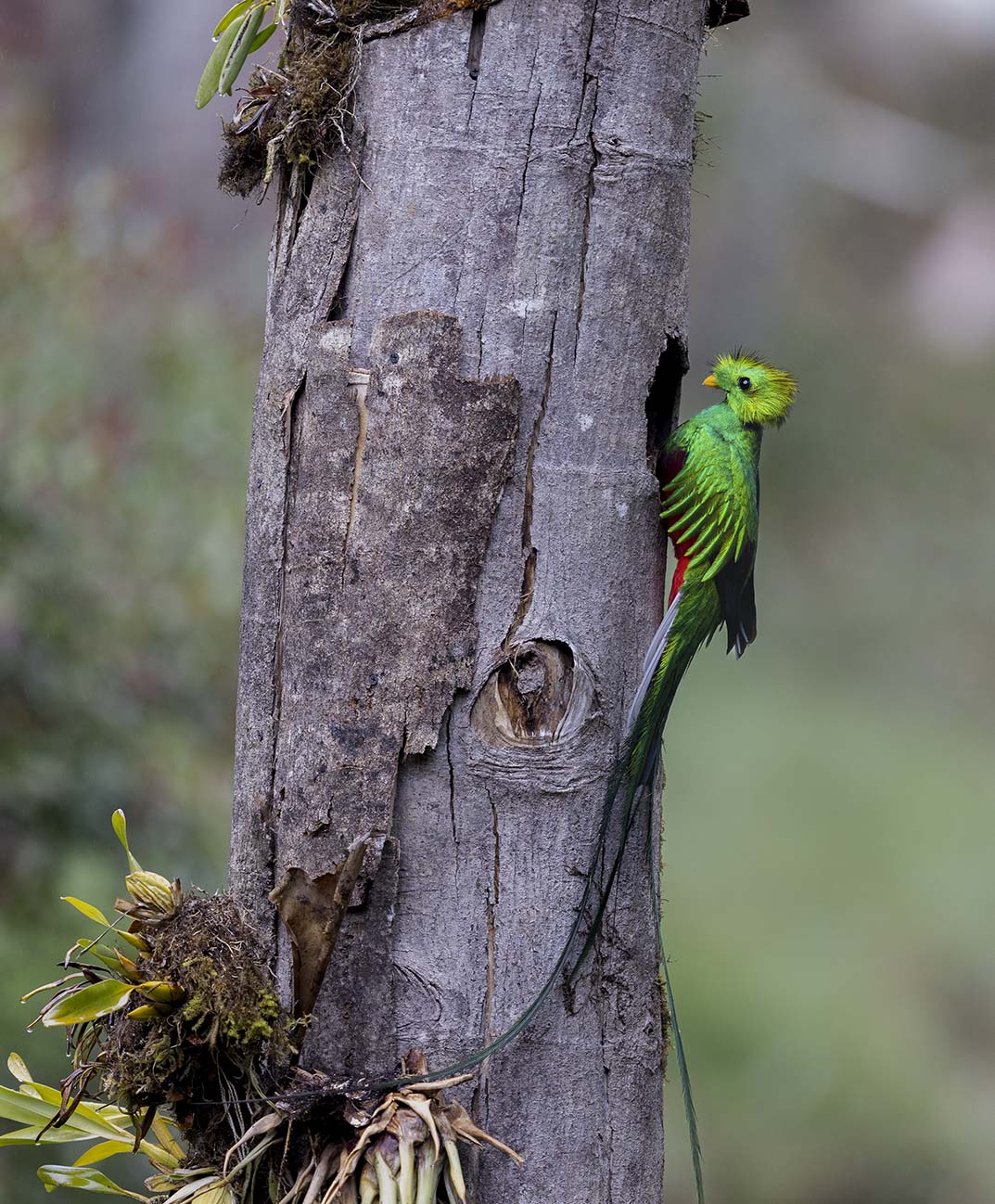 The male arrives for his turn at incubating
the clutch. From this vantage point I have a good view of the nesting hole, but I pretty much missed the approach.
The male arrives for his turn at incubating
the clutch. From this vantage point I have a good view of the nesting hole, but I pretty much missed the approach.
I retreated back inside the viewing platform and this time I politely requested the photographer in front of me if he might consider remaining seated. My brother, meanwhile, was having the time of this life, with a clear view of the flying Quetzals and unburdened by the tyranny of the 'perfect shot'. We took selfies, grinning happily that we had yet again seen the Resplendent Quetzal and this time it was the female as well. I admired the gallery of photos that was tacked on the wall, action shots and portraits of activity around the nest.
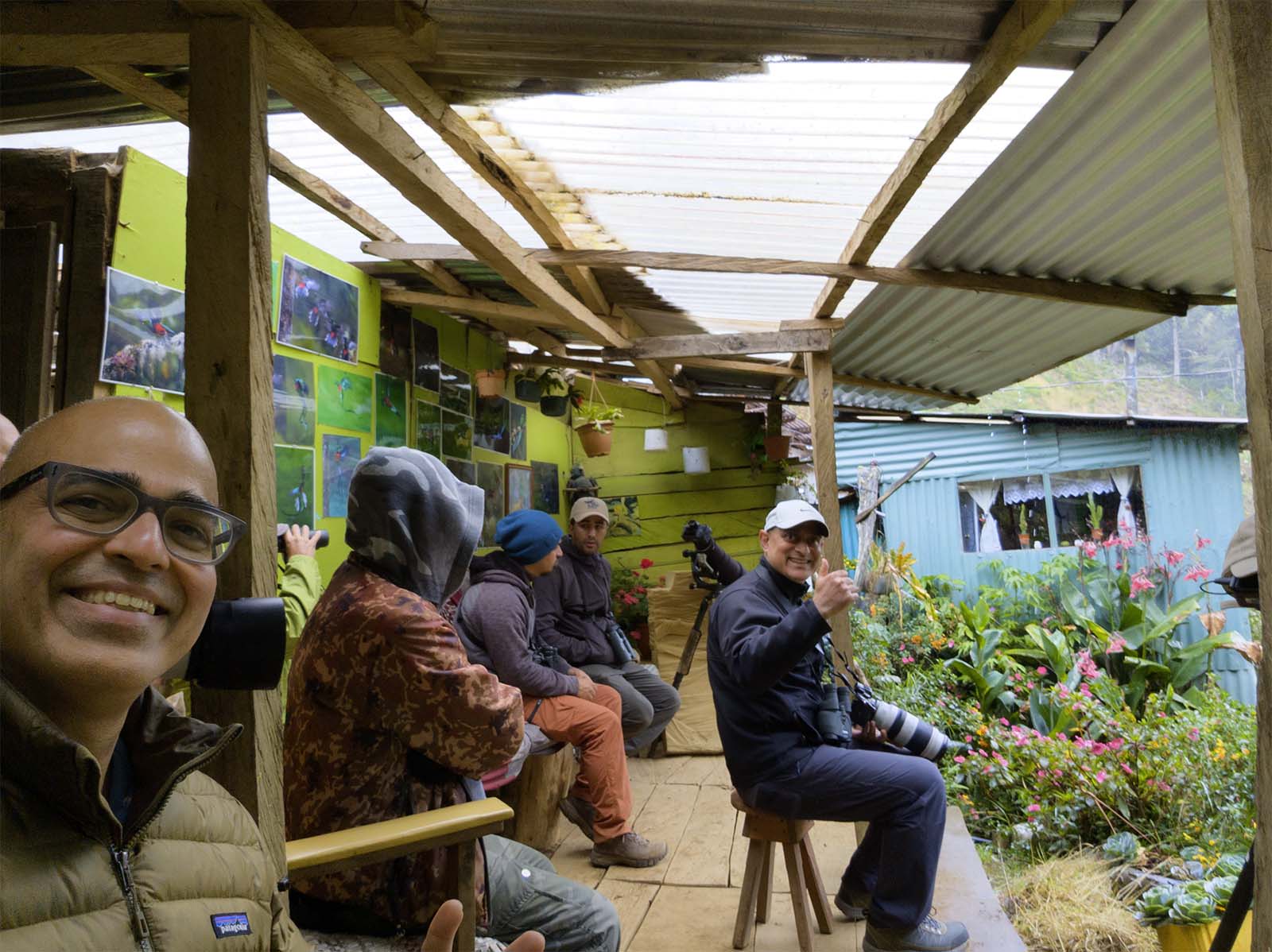 With the male Quetzal now inside the nest
we know it will
be a long wait till it re-emerges, so that is an opportunity to move around and meetup with my brother.
With the male Quetzal now inside the nest
we know it will
be a long wait till it re-emerges, so that is an opportunity to move around and meetup with my brother.
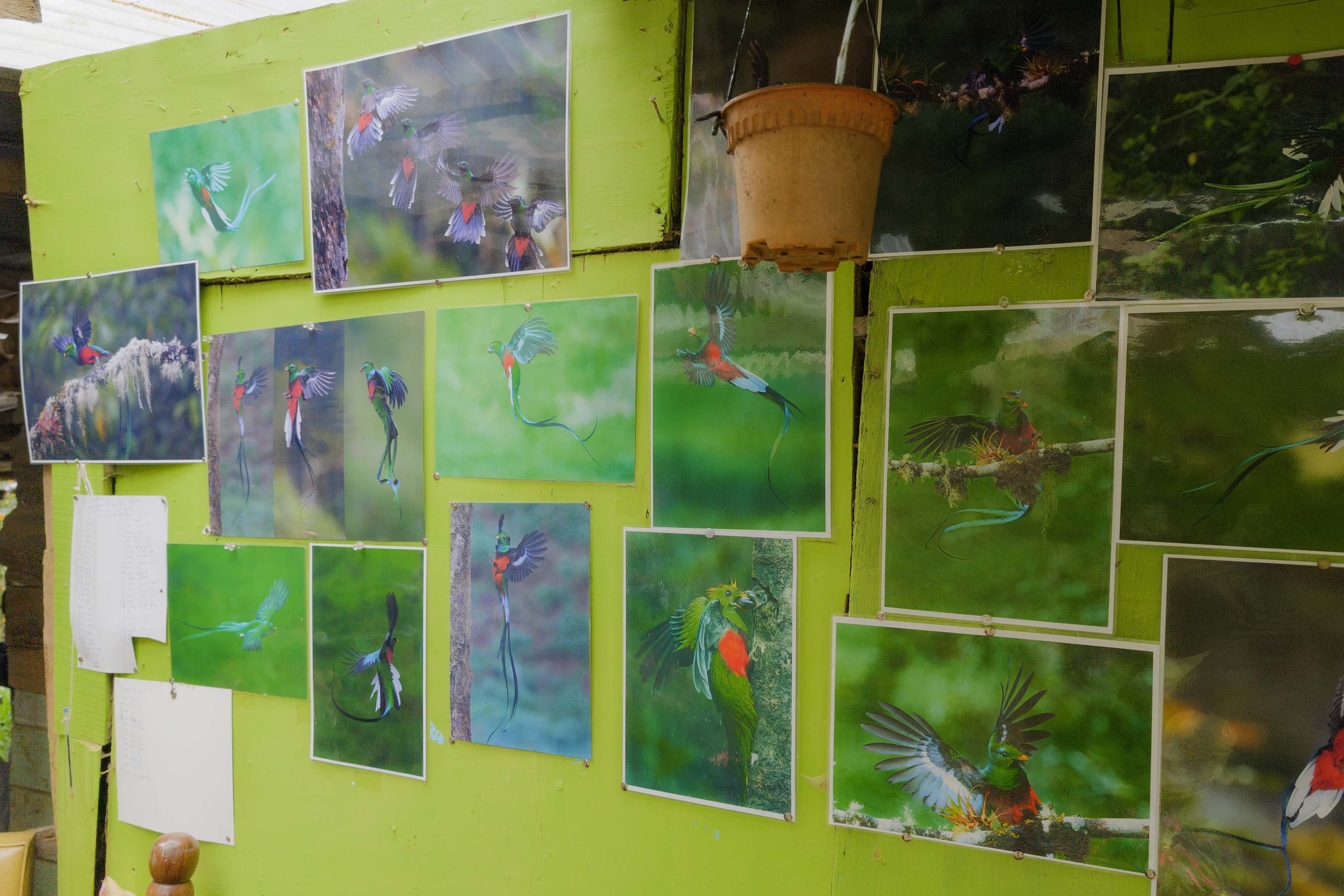 A collection of prints showcasing the male
Quetzal in various poses. In several of those photos, the male brings an Aguacatillo berry to its chicks.
A collection of prints showcasing the male
Quetzal in various poses. In several of those photos, the male brings an Aguacatillo berry to its chicks.
I struck a conversation with a lodge employee and that is how I learned about the Kabek conservation program: farmers and landowners partnering with the Paraiso Quetzal lodge to earmark portions of their land as natural habitat for the Quetzal in exchange for tourism dollars. The program, in its second decade has borne fruit as the word about conservation of habitat has spread through the Talamanca highlands and several farming families now participate in habitat protection. While the eco-tourism keystone species is the Quetzal, saving what remains of the cloud forest is beneficial to all species that call it home. From his pocket, he pulled out a small twig with green berries - the Aguacatillos (Spanish for small avocados) were key in the Quetzal diet. He had recently seen young trees about ten miles away and was in talks with the land owner to keep that habitat undisturbed.
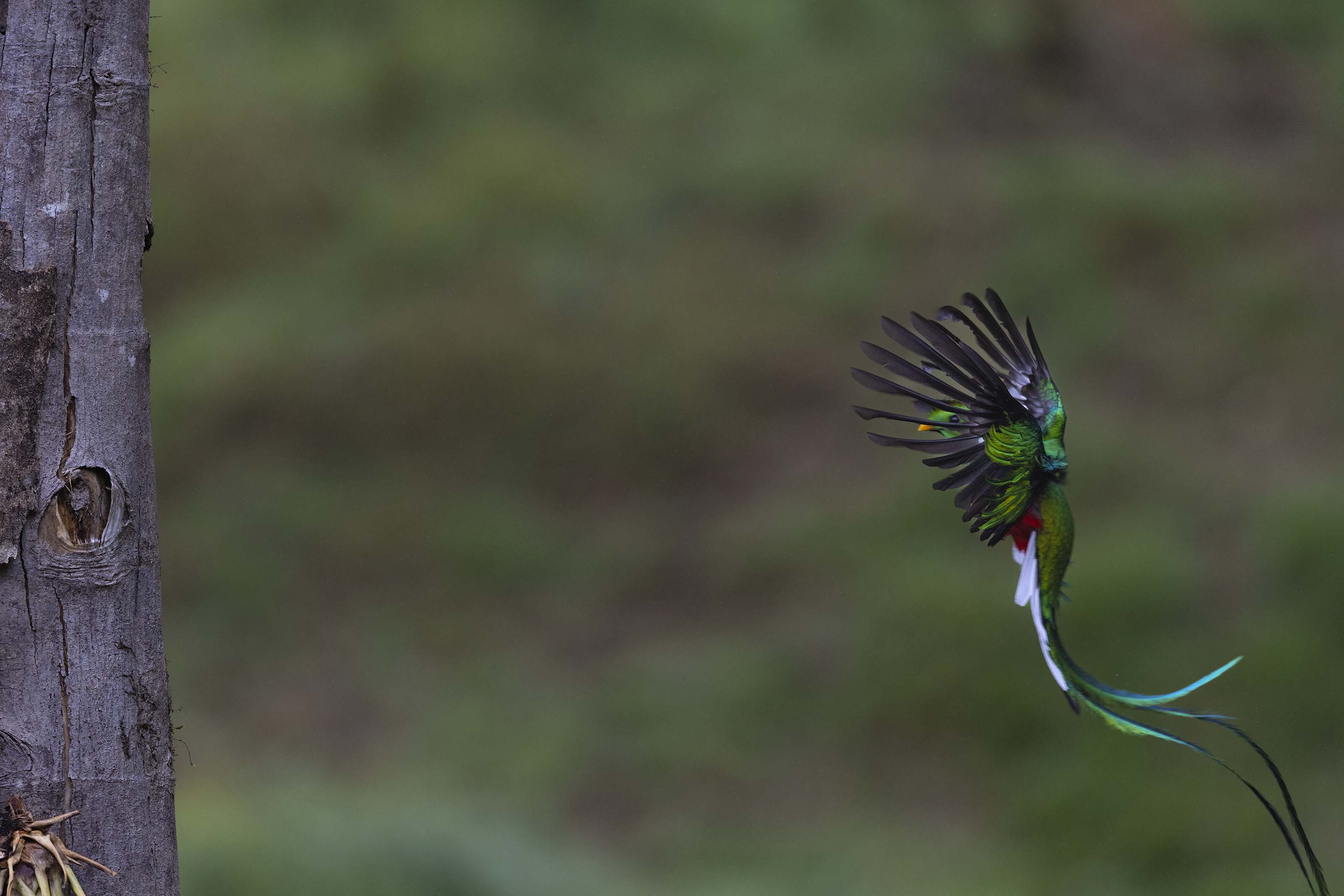
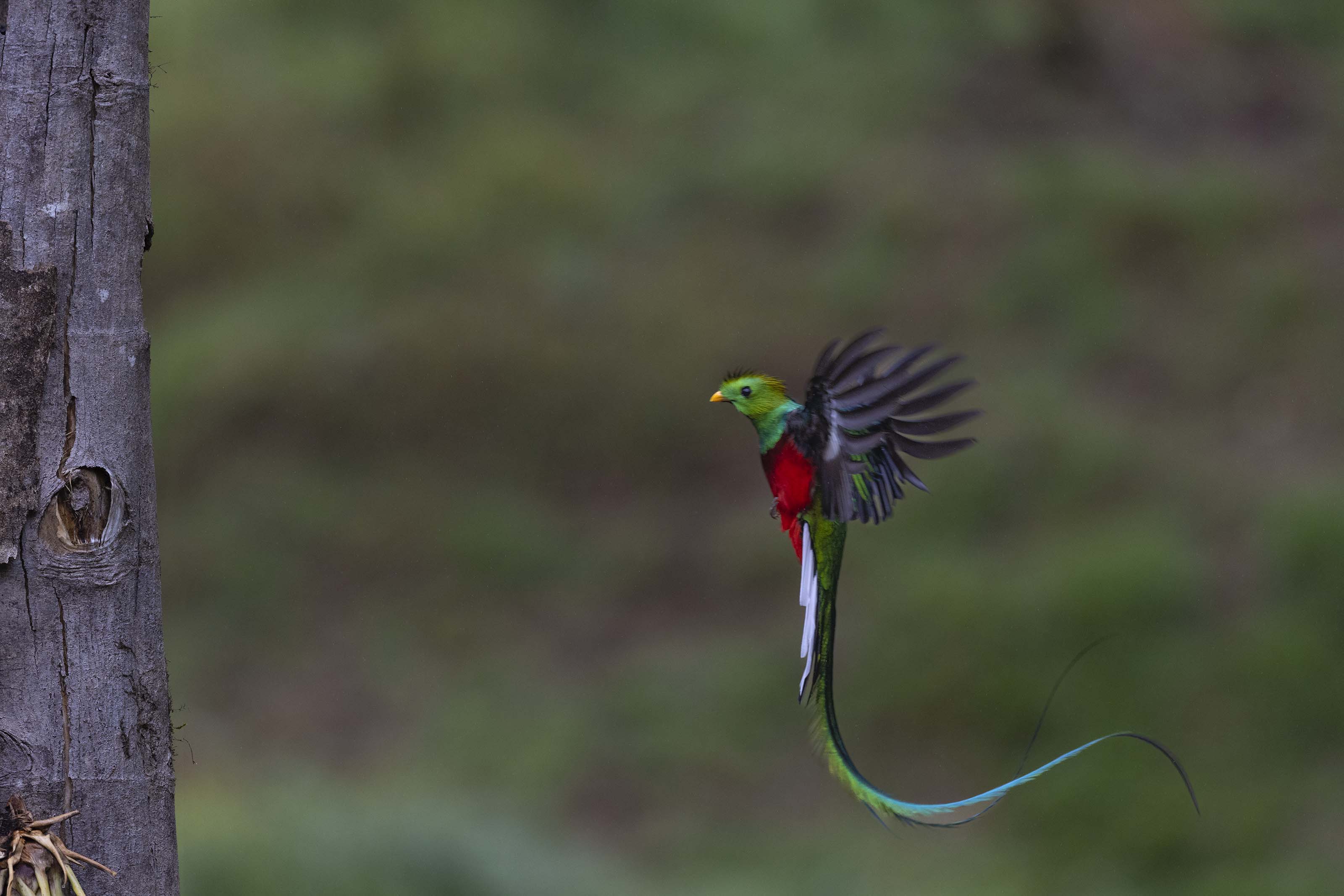
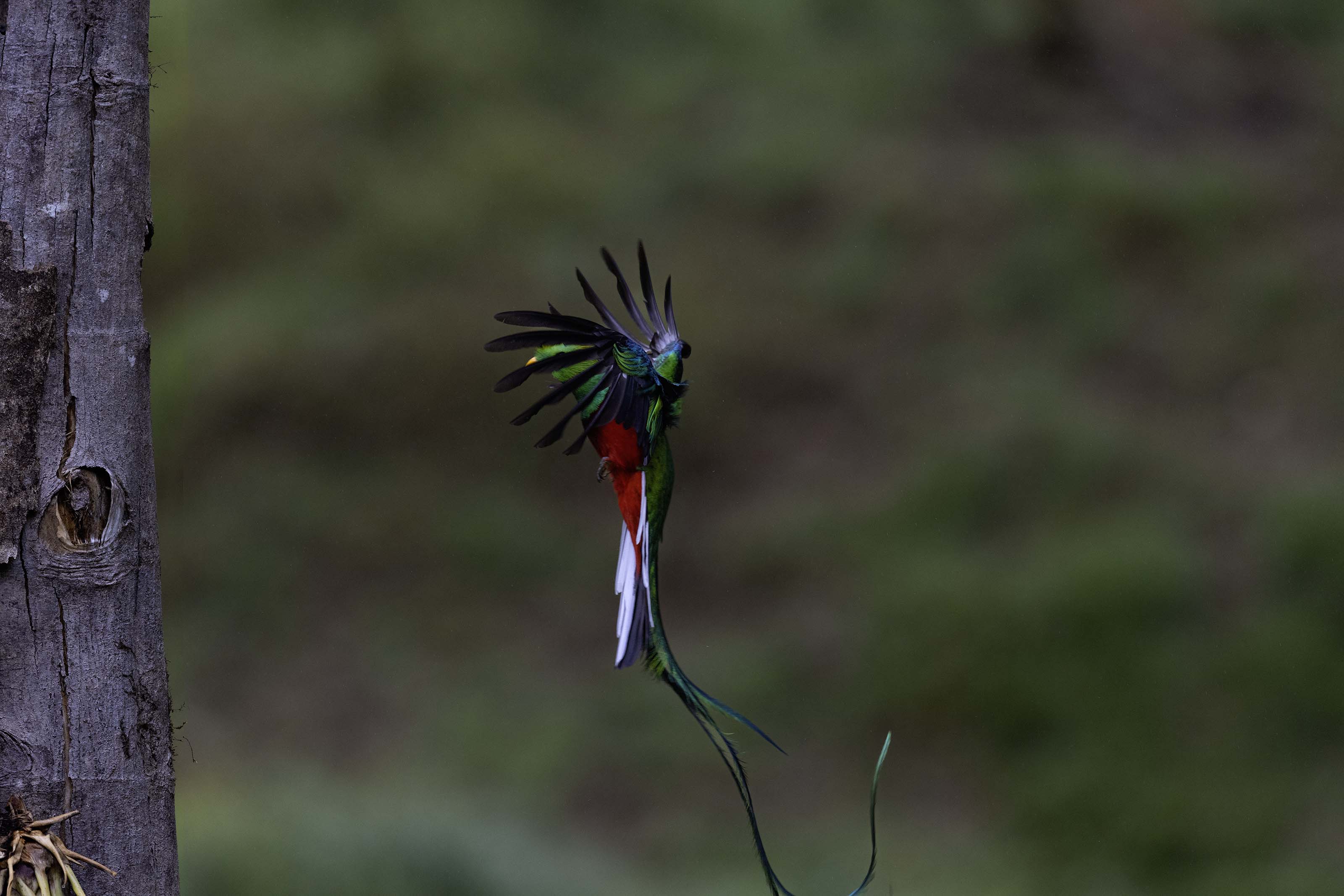
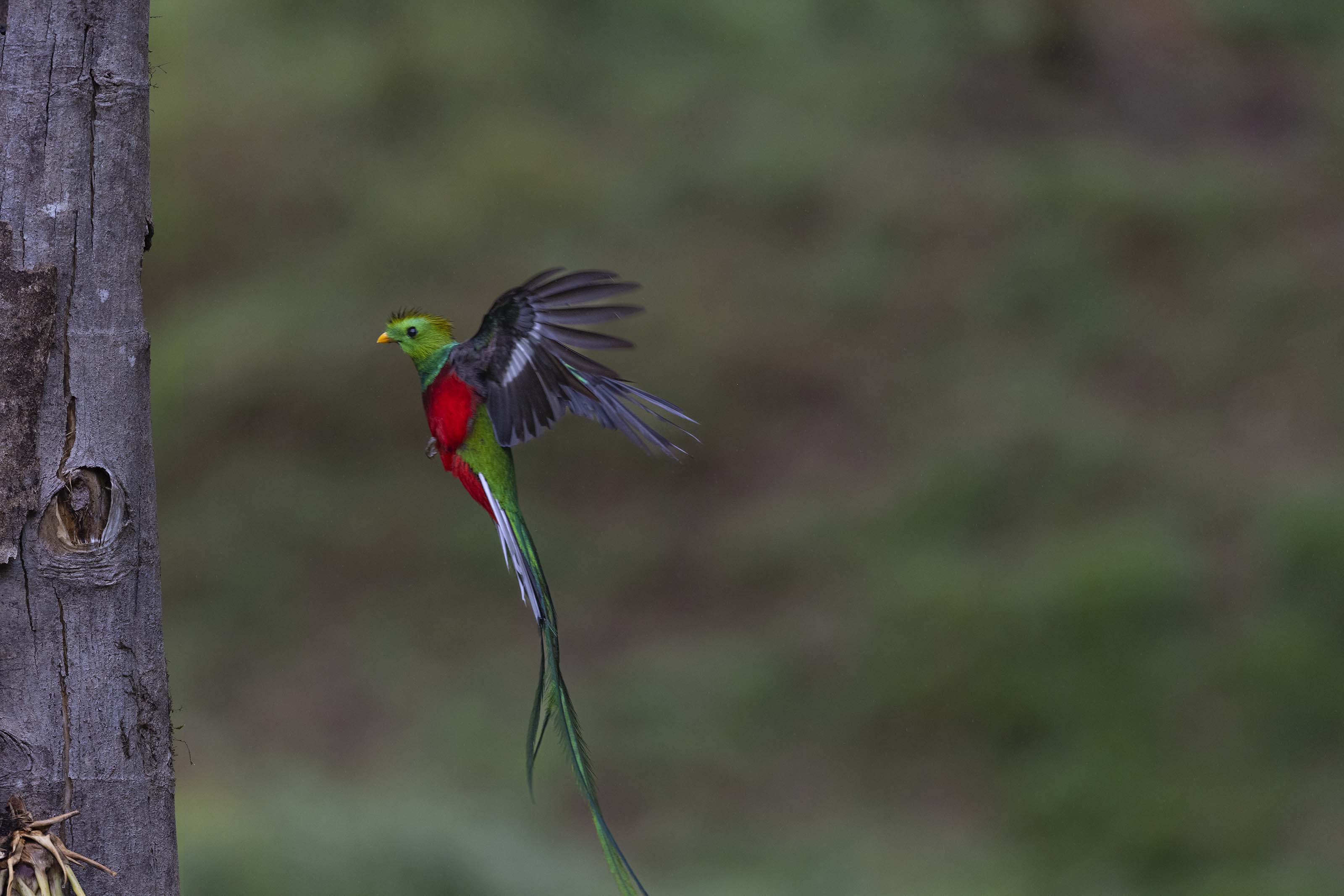
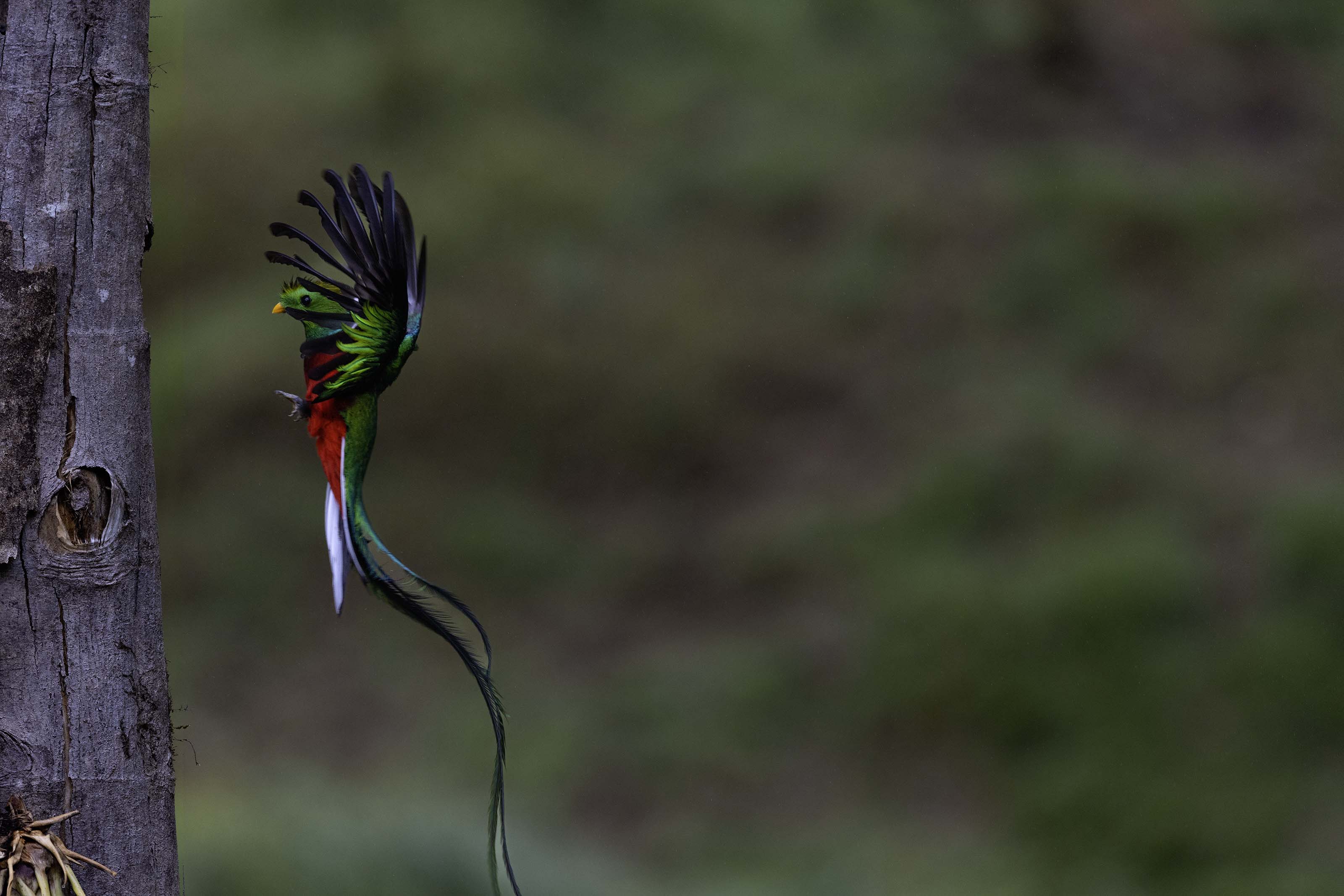
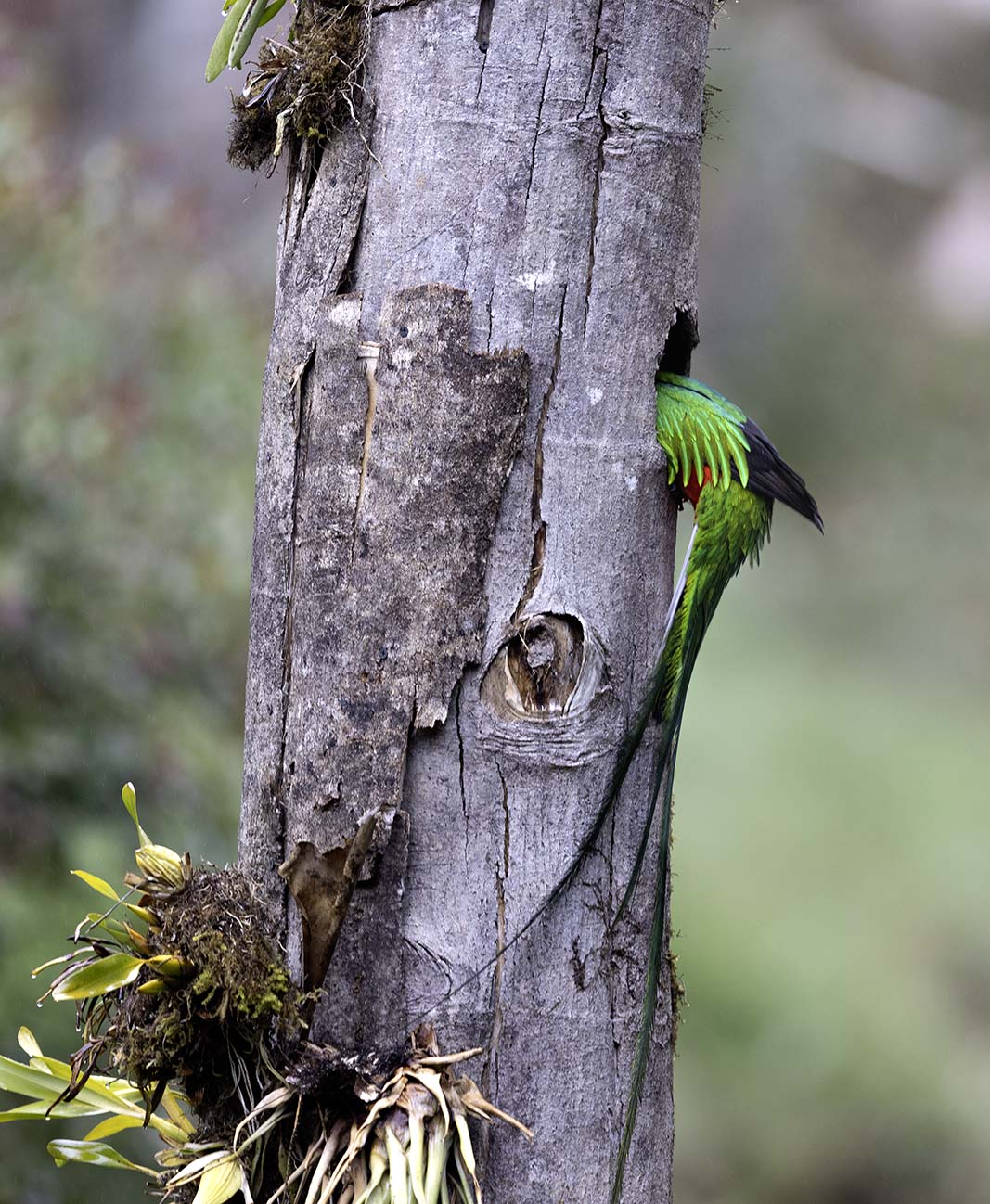
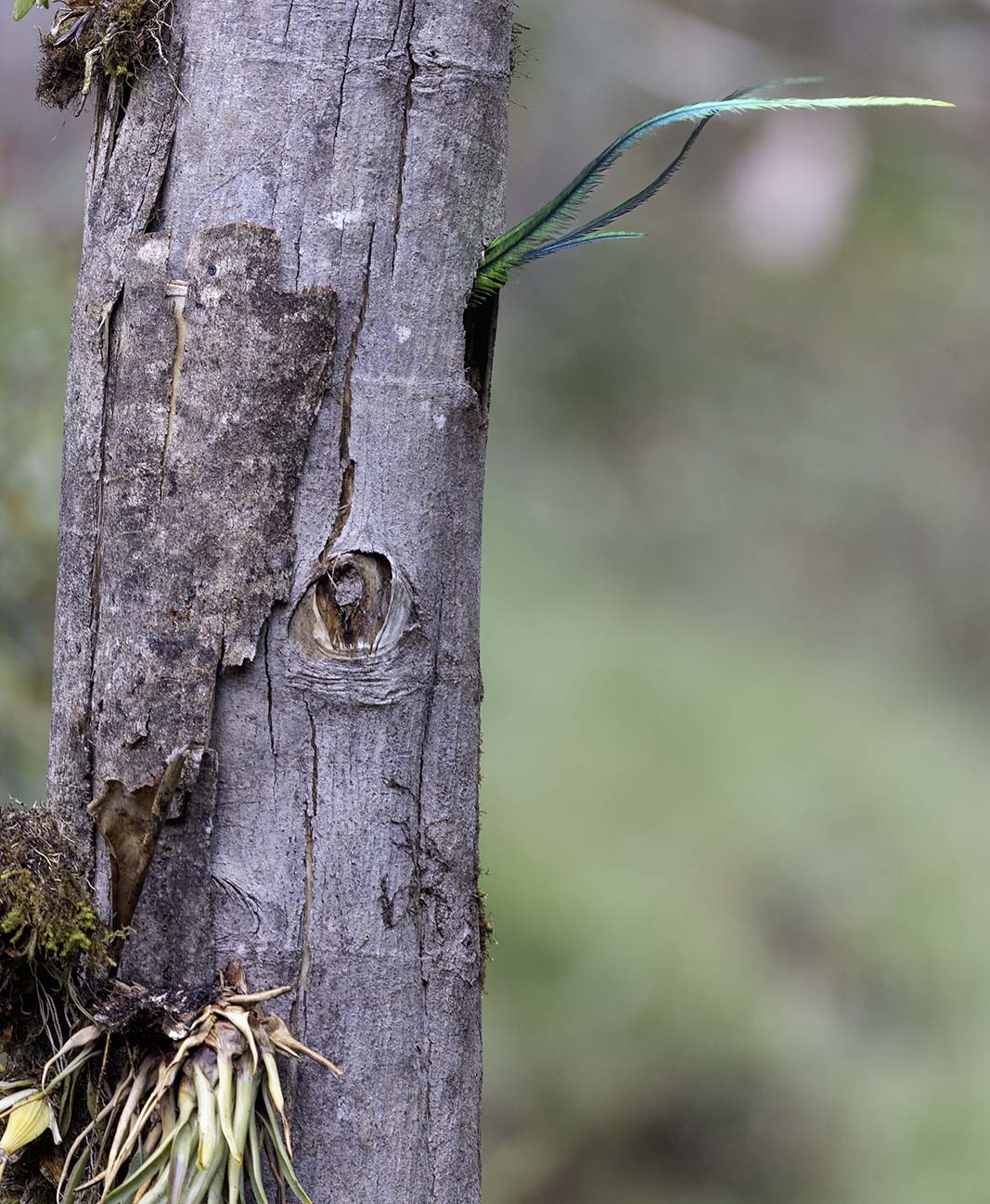
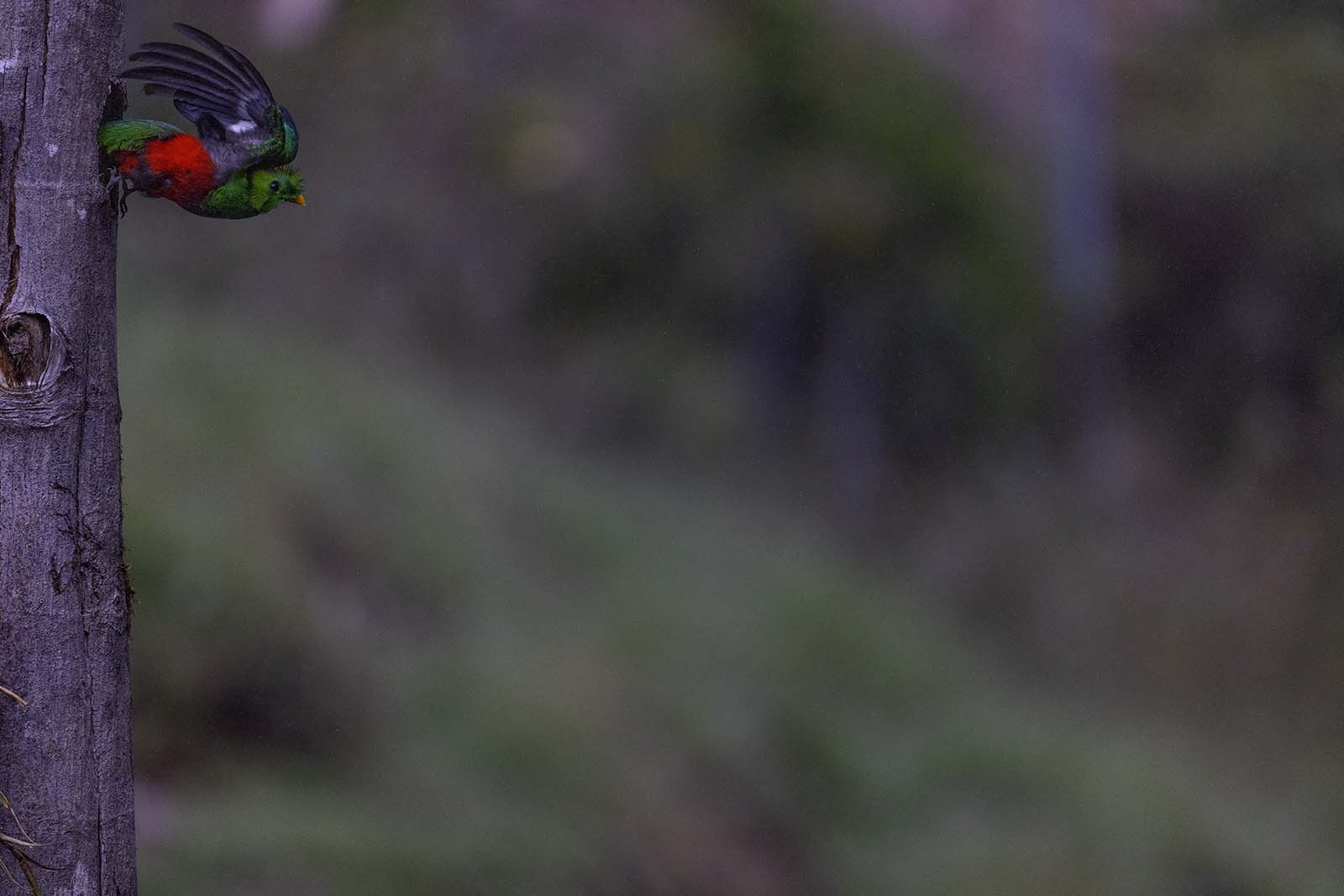
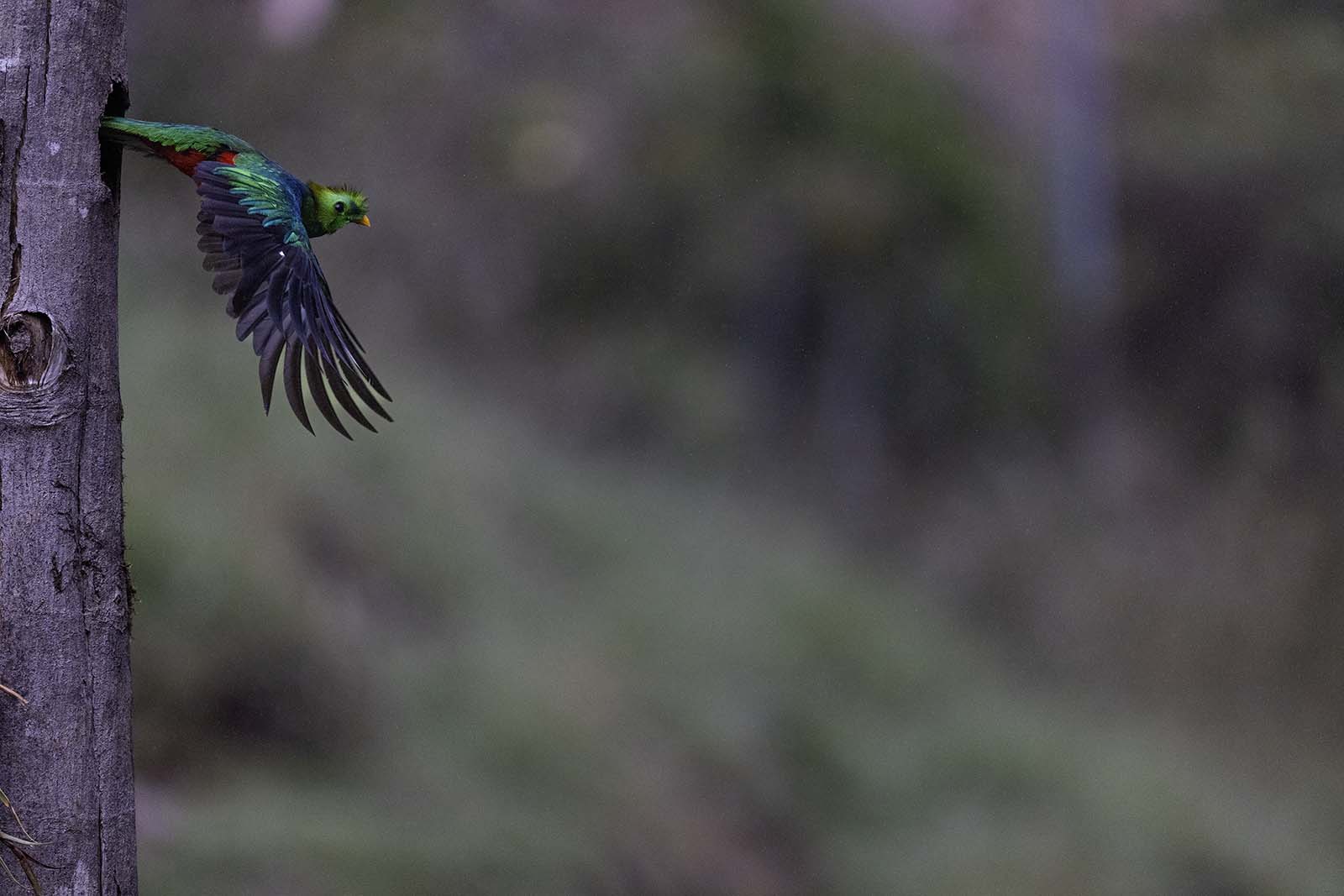
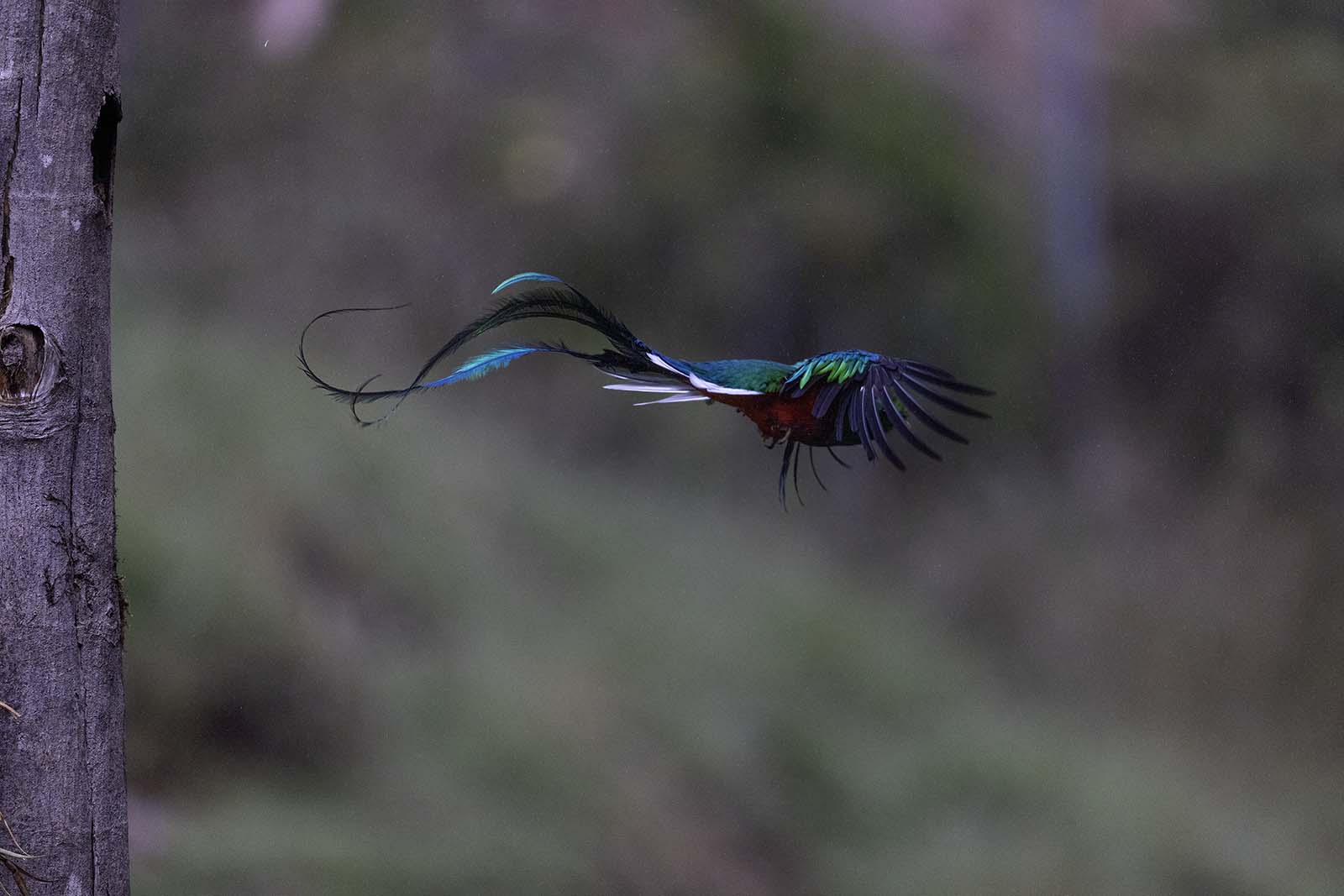
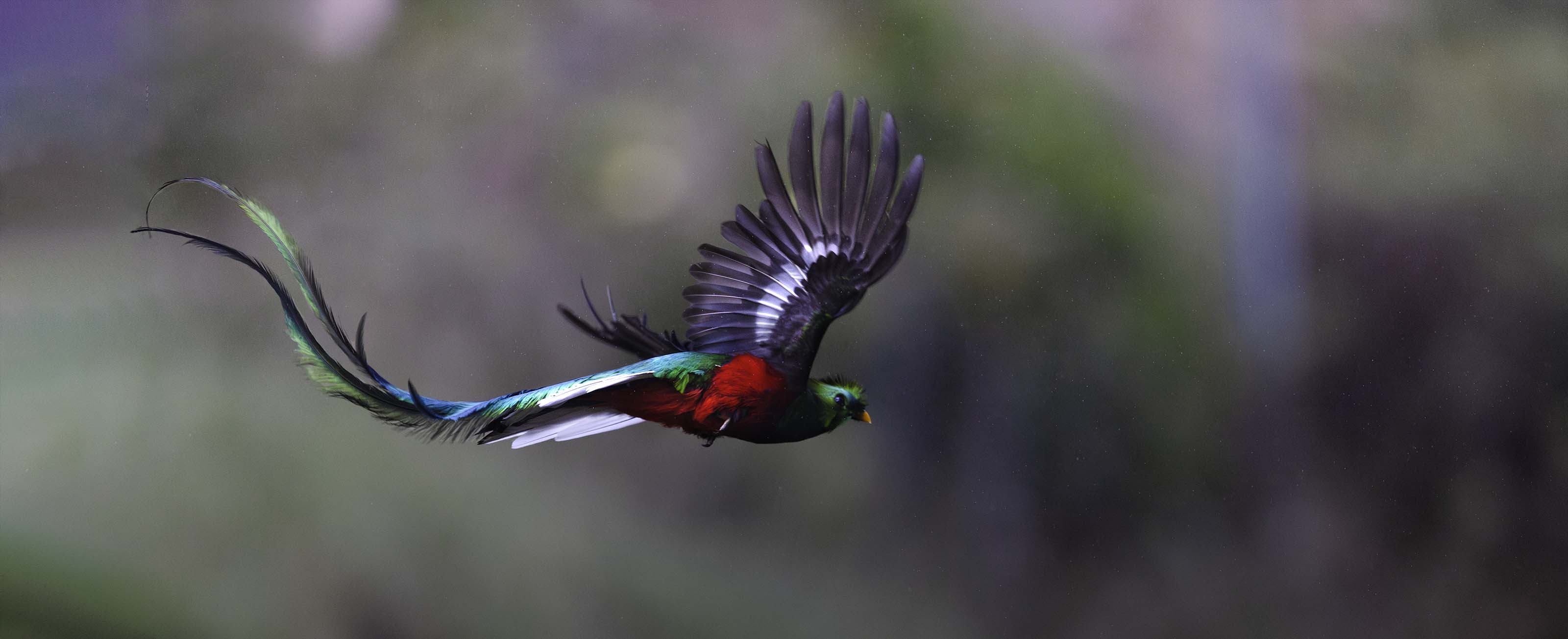
It was another long interval before the male re-emerged. Just before he did, I saw his twin two-foot-long tail feathers, disappear entirely into the nest. How the bird contorts itself to fit that absurdly beautiful train into such a cramped space is a marvel. This time I was ready for the takeoff flight. Every small movement by the male made me twitch and I would fire a burst of shots. Finally, in a flourish it launched itself, first dipping downwards as it exited the nest and then flying right over the staged perch and into the hillside vegetation. This time, I am satisfied with my capture (a sequence of photos).
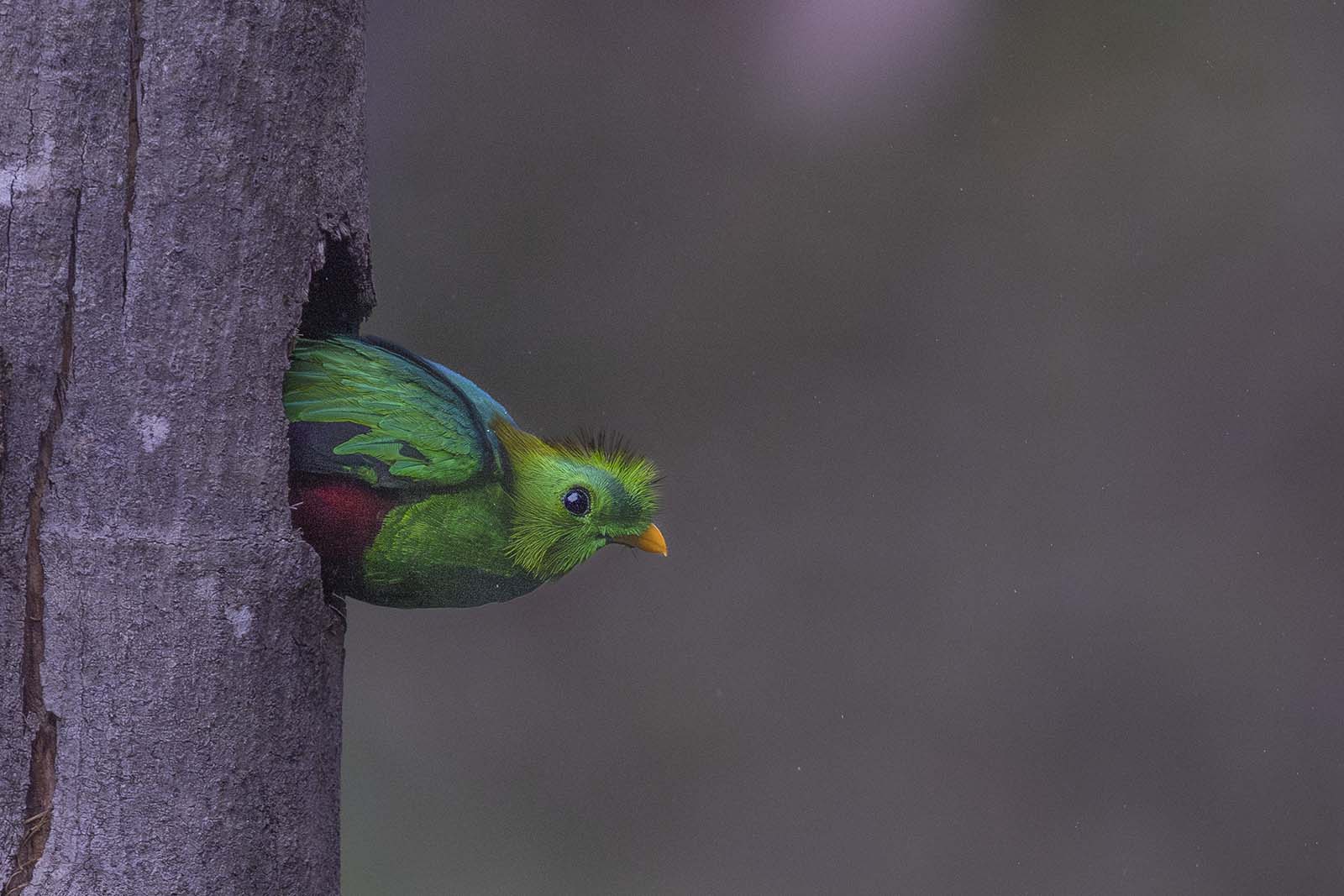 Amazingly, the male Quetzal has done a U-turn inside
the nest cavity with his tail feathers tucked away and is now ready for his departure.
Amazingly, the male Quetzal has done a U-turn inside
the nest cavity with his tail feathers tucked away and is now ready for his departure.
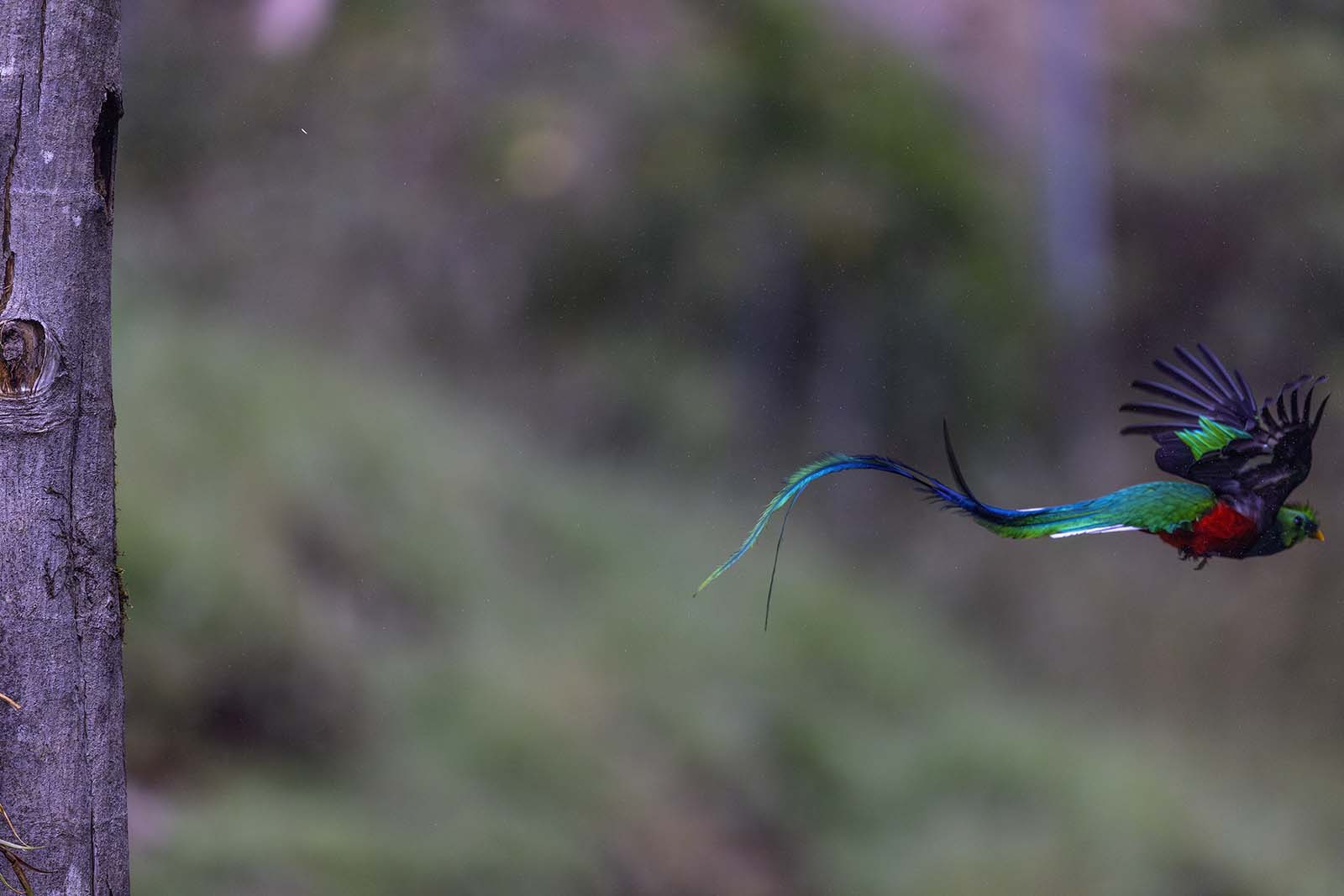 The flight of the feathered serpent. With the
streamers rippling behind the bird, one can see why the MesoAmerican deity got its name after this bird (Quetzal, from the Nahuatl language,
referring to a bird with beautiful green feathers, and Coatl, meaning serpent)
The flight of the feathered serpent. With the
streamers rippling behind the bird, one can see why the MesoAmerican deity got its name after this bird (Quetzal, from the Nahuatl language,
referring to a bird with beautiful green feathers, and Coatl, meaning serpent)
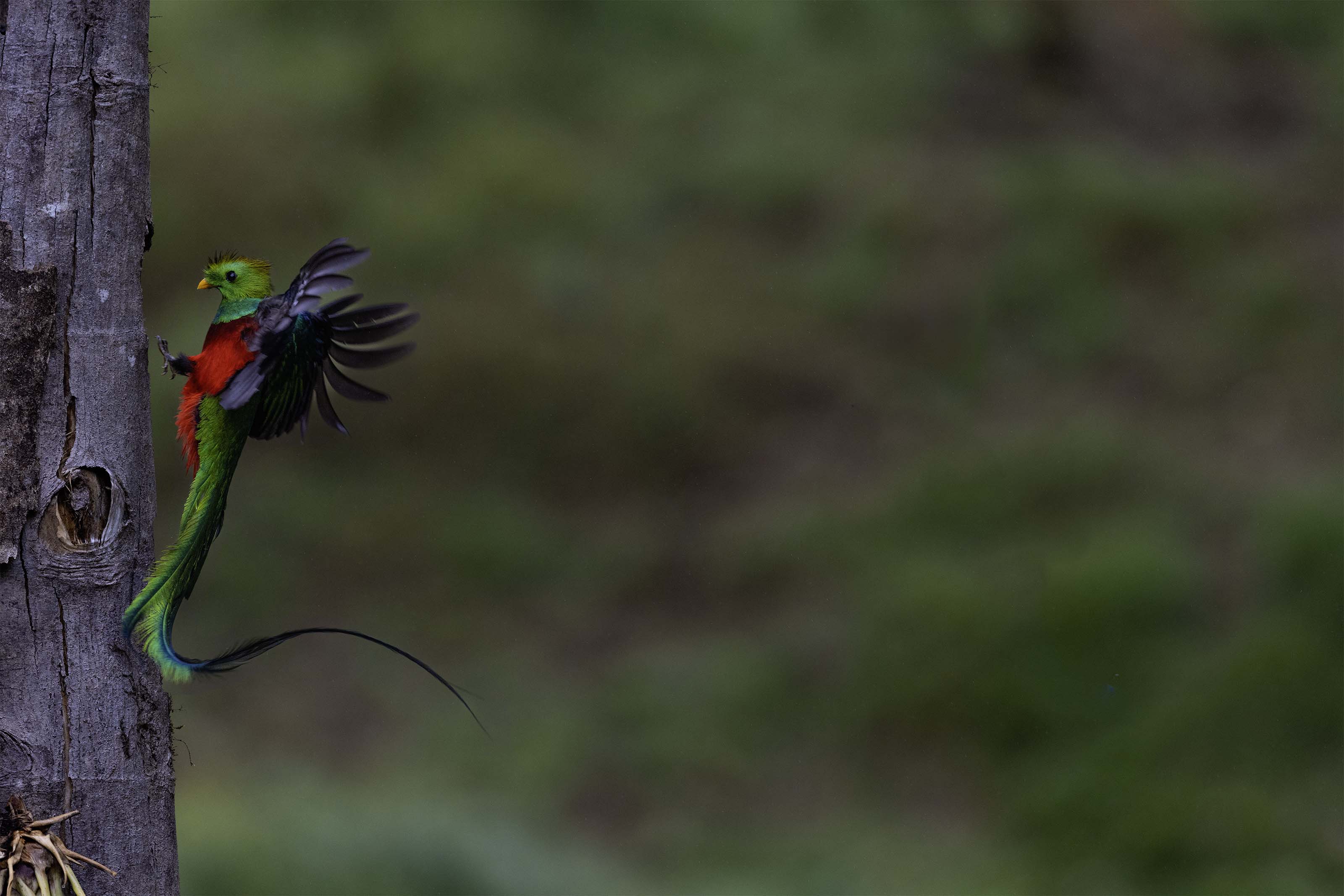
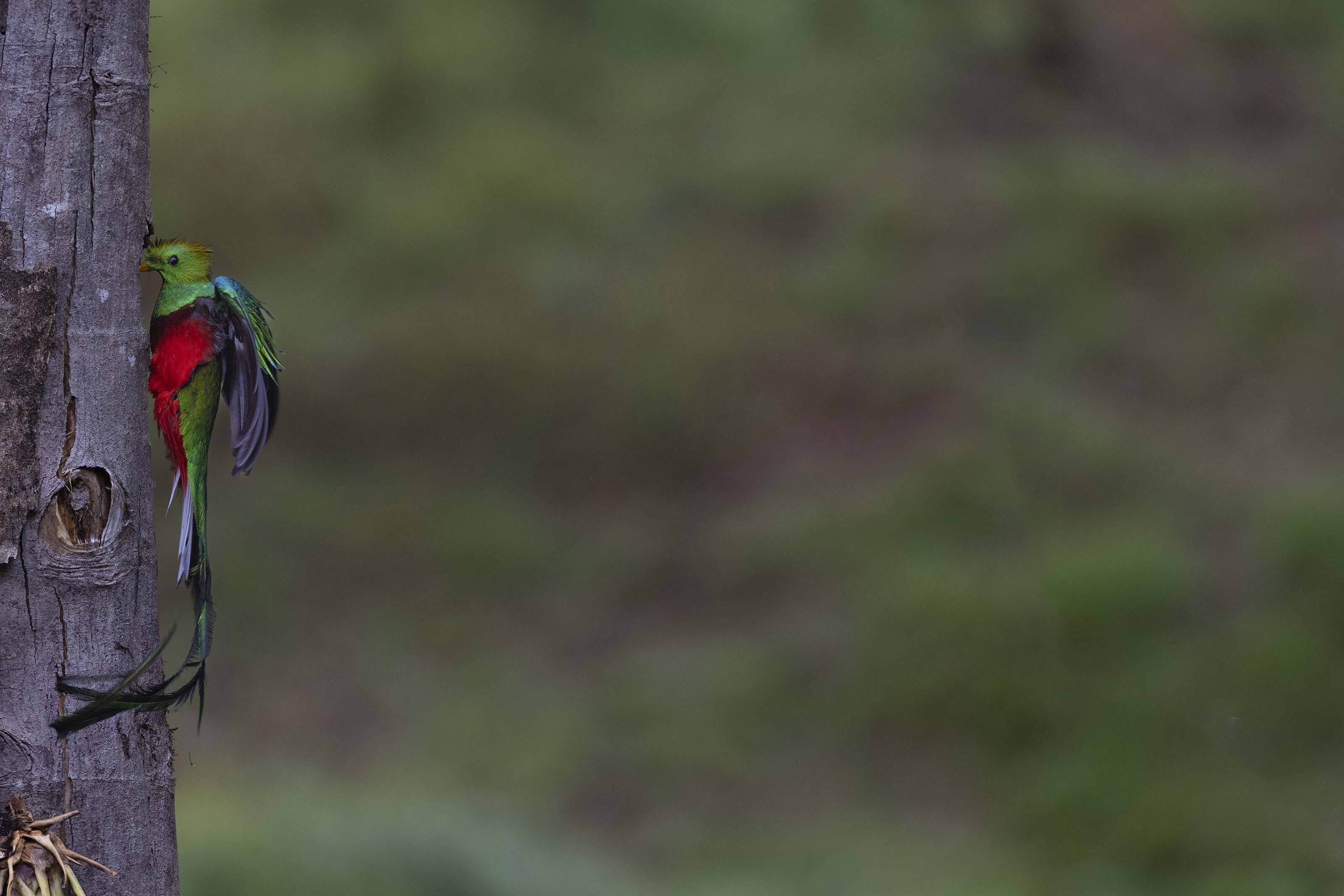
Another long wait and there is a sense in the crowd that this is the last chance to see the Quetzal before we lose the light. It is not possible to pan my long lens, as the action that unfolds is over in a couple of seconds and the Quetzal essentially fills my frame, so I keep my lens locked at the tree. The male Quetzal does not disappoint. Arriving in a flourish, it performs a sudden mid-air brake, wings spread wide, its small feet reaching for the edge of the nesting hole. Another set of rapid fire images, arranged as a carousel show the Quetzal's re-entry.
The photographer next to me comes over to check my photos. He's captured a good sequence as well and we congratulate each other. Cameras start going into bags and chairs start folding. I head to my brother and show him the photos. He is delighted and the whole experience of viewing the Quetzal couple multiple times today will stay with us for a long time.
Meditations
Von Hagen's expedition was ostensibly scientific but wrapped with a veneer of
colonialism, and in his own writing : a quest to
"destroy a legend that" had stood for hundreds of years : that the sacred bird of the Aztecs,
could not, would not, live in captivity.
At the end of his book, he writes about his encounter with a venomous snake. His book ends thus :
But as I recovered from the terror that had shaken me I became aware of another emotion like triumph. Now I had lived the ancient myth of the serpent and knew its meaning. I had captured the Quetzal and killed the snake that spat on my hand. I had come here to destroy a legend, and the truth in it had come alive and nearly destroyed me.
Several fledglings were trapped and brought to his encampment where he nourished them for weeks before drugging them so that had a chance of surviving the long return journey by land and sea. The birds made it to the zoos but did not last very long. The London Zoo purchased three male and three female Quetzals but all had died by 1941. The Bronx Zoo purchased three Quetzals, but two died within eight months and the third survived for just over a year. von Hagen never mentions this in any of his books.
Hence the allure and the legend of the Quetzal continues - requiring us to pay a visit to its homeland.
Ecotourism is a deeply modern arrangement, and this experience with the Quetzal at the nest was curated, a guaranteed 'product' of services rendered since farmers work closely with the lodge to notify Quetzal activity and direct tourists to the most active nest. I asked the lodge employee what portion of our fee went to the farmers and the conservation fund. He demurred but responded by saying that the distribution of funds was kept equitable between all farmers who participated in the program.
We are happy to contribute towards a movement that protects the bird and its habitat with the idea that it is also economically advancing the people who inhabit the land - but with a visit this short it is not possible to grasp where the lines between conservation and commerce are drawn. The hide we visited receives dozens of photographers each day in the breeding season (roughly April through June) and there were signs of the pressure of increased visitation throughout the property. On the flip side, I did gather that the commerical success of this program has incentivized participating farmers to actively plant Aguacatillos and other fruit-bearing trees on their properties, demonstrating a direct economic incentive on habitat preservation and expansion on private land.
Eco-tourism and eco-adventurism, in my humble opinion, should always place the welfare of the animals first with tangible
benefits for local communities. I see lodges like Paraiso Quetzal provide a concrete, illuminating example of a direct
and impactful system. The onus is thus on the visitor to be well informed of the promotions
and conscious of their choices with the hope that such choices will endorse the sustainability of these tourism activities for
many more generations to come.
Published 12th July 2025
References
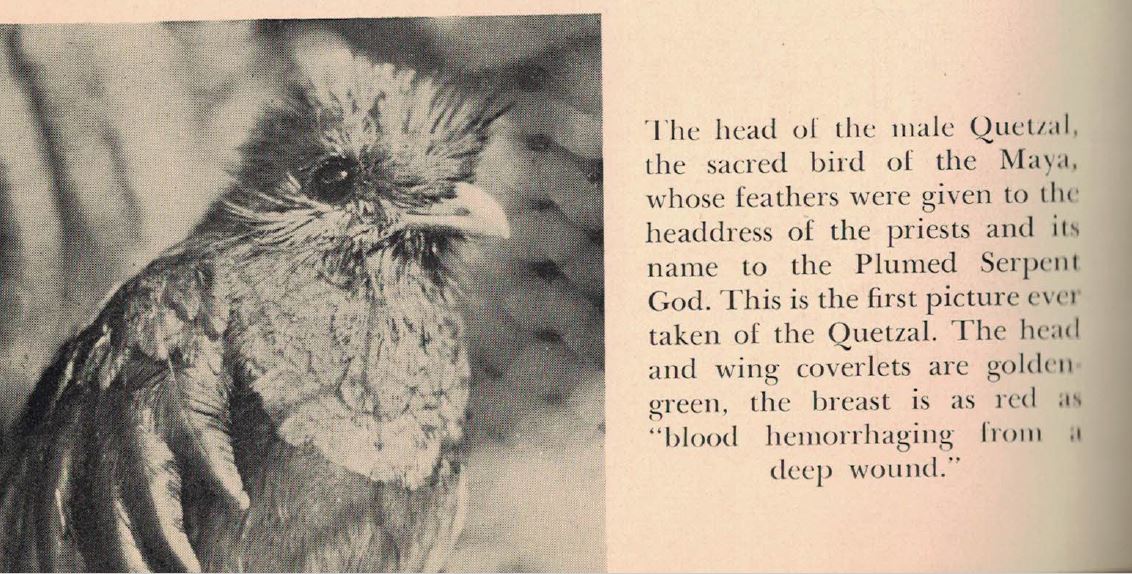 The first photo ever taken of a Resplendent Quetzal (very likely it was captured given
the proximity to the camera)
The first photo ever taken of a Resplendent Quetzal (very likely it was captured given
the proximity to the camera)
Behavior and Feather Structure of the Quetzal, A. LaBastille, D. G. Allen and L. W. Durrell, The Auk, Vol. 89, No. 2 (Apr., 1972), pp. 339-348.
https://www.youtube.com/watch?v=67tl14YJBGY. A video that I found on YouTube that describes the Kabek program.
https://dwazoo.com/conservation/mexico/resplendent-quetzal-breeding-program/. A website that has a brief mention on the rearing of the Resplendent Quetzal in captivity.