Endurance Athletes
World Migratory Bird Day, celebrated with birding events on October 11, is full of stories of endurance and amazing journeys. As a kid, I had read about the migration of the Arctic Tern, the chaser of the endless summers from Pole to Pole and the world record holder of longest migration by any animal. But until recently I was oblivious of what migratory birds were truly capable of until listened to a presentation about a rather ordinary looking shorebird called Bar-Tailed Godwit (Barwit for short) that commands our awe for a non-stop ! flight from their Alaskan breeding grounds to New Zealand each September.
Imagine this: A tiny speck, un-noticed, flying over the Pacific Ocean. More than ten days of flying and
over 7,000 miles with no rest, no sleep, yet
fully commited and focused
as even the slightest misjudgement of course could place it hundreds of miles
away from land.
A Barwit will start in Alaska fully laden with stores of fat for its long haul flight
and arrive completely emaciated in New Zealand.
Why? you wonder, do these birds push themselves to their limits.
Yet, even that epic journey in distance meets it match in what I now consider the ultimate act of will-power and bravado in migratory flight. It’s a journey undertaken by a creature weighing less than a nickel: the Ruby-throated Hummingbird.
Each spring, legions of them line up at the edge of the Yucatán peninsula, then launch themselves over the open waters of the Gulf, aiming for the coastal plains of Texas and Louisiana. A non-stop, 500-mile flight that takes 18 - 24 hours sustained by nothing more than mere gram of fat.
When I watch the frenetic, ever-hungry hummingbirds in my own backyard, zipping from flower to feeder, the idea seems preposterous. How can a creature so defined by its constant need for re-fueling simply turn off the impulse to feed every twenty minutes and fly off into the horizon? So many things could go wrong for a bird that small. So many things have to line up perfectly for this bird to make it to the other side.
So how do we know that the hummingbirds are indeed crossing the Gulf. Well, thanks to the sightings of thousands of birders, we have a 'birds eye view', pun intended ;) of this migration beautifully displayed on eBird. In the fall, we see the hummingbirds trickle south, hugging the coastline of the Gulf. But it's the spring that reveals the true drama. Using the data of sightings so nicely coalesced by the eBird weekly abundance map (a great starting point to explore all birds is here and the webpage specific to the Ruby-throated hummingbird is here) , we see a gathering of tiny engines at the Yucatán peninsular tip in the weeks of 8th and 15th March. Then in the weeks from 22nd March to 5th April, sightings start to erupt around Texas, Louisiana, Alabama and the Florida panhandle. The birds have made their jump and have started to disperse ! Around April 5th we also start to see the coastal migration route take shape and by April 26th, both migration pathways are in full swing.
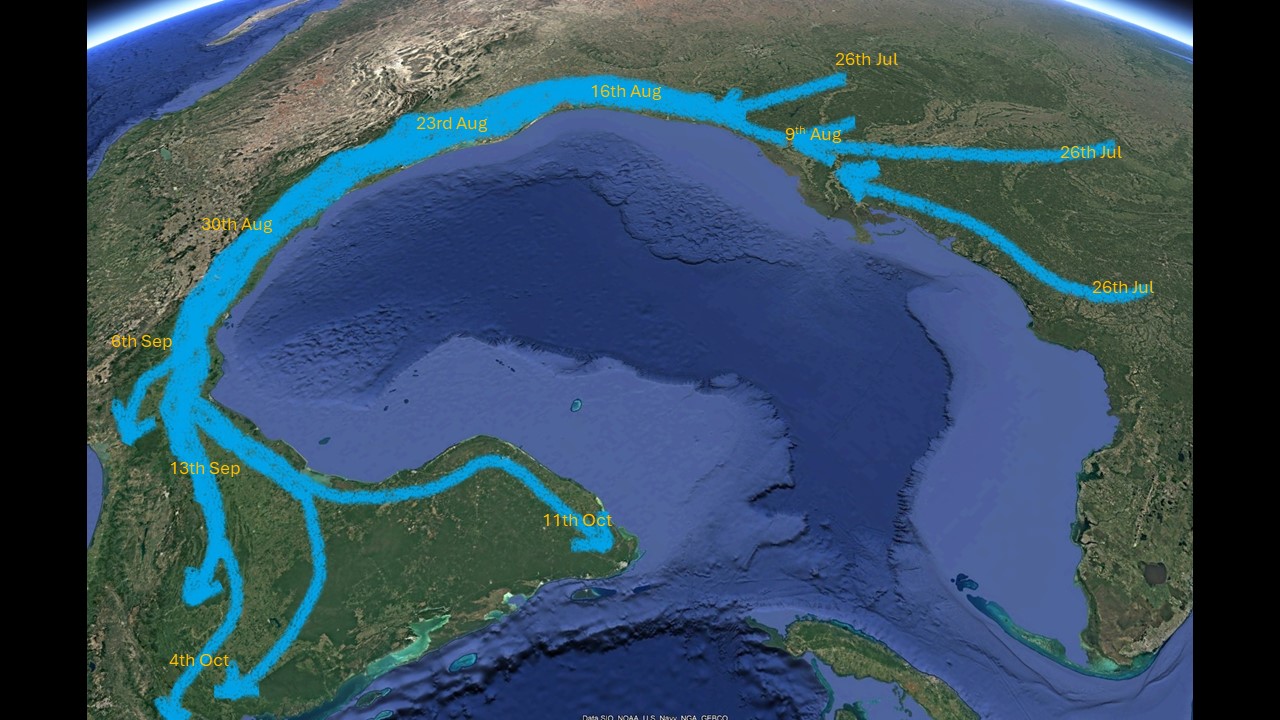
 Fall migration
of the leading waves of the Ruby-throated hummingbird mostly follows the curve of the Gulf,
from the coastal areas of Texas down to central Mexico, with large stopovers around Mexico City,
the Yucatán, and other hummingbirds continuing further south towards Costa Rica, reaching
Central American countries by the end of the calendar year.
Fall migration
of the leading waves of the Ruby-throated hummingbird mostly follows the curve of the Gulf,
from the coastal areas of Texas down to central Mexico, with large stopovers around Mexico City,
the Yucatán, and other hummingbirds continuing further south towards Costa Rica, reaching
Central American countries by the end of the calendar year.
Source: Google Earth Pro for the globe, eBird abundance map for the dates and my crayon marks and date overlays.
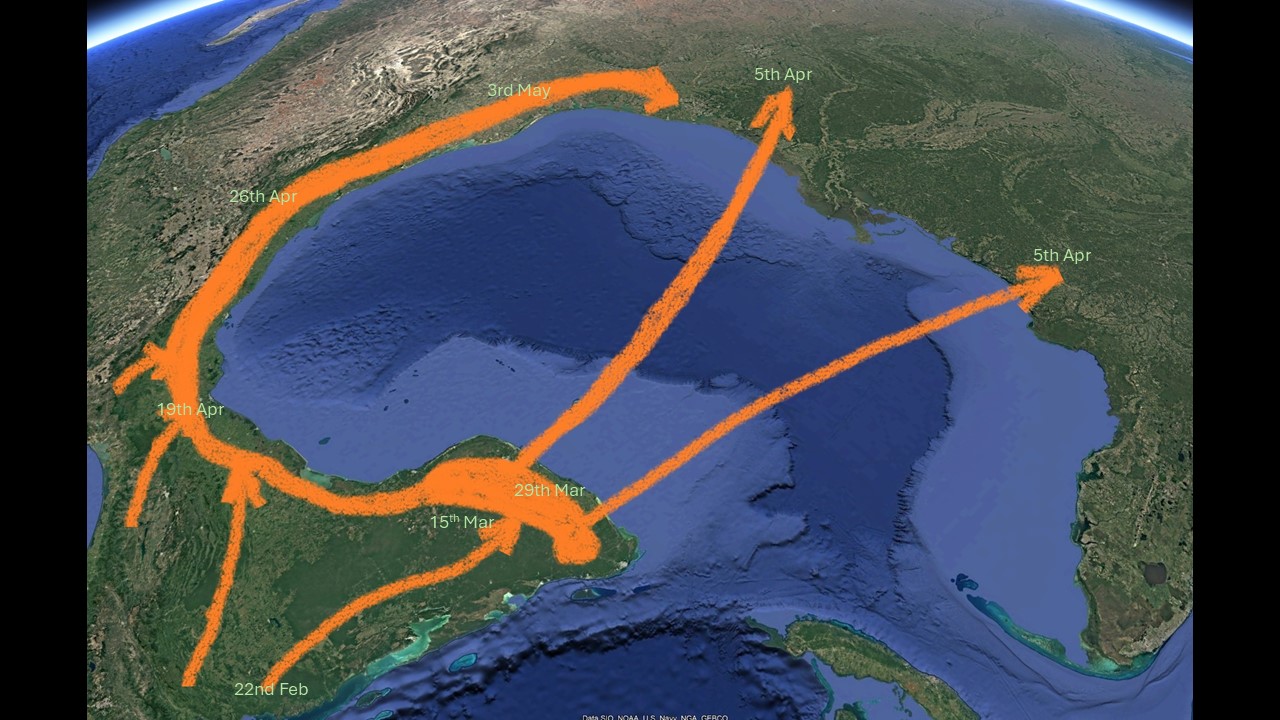 Spring migration
of the leading waves of the Ruby-throated hummingbird starts with intrepid birds taking off across
the Gulf of America and making landfall in about 24 hours. These birds seem to arrive from Central
American countries and congregate in the Yucatán in the first week of March.
Another large wave starts around the second week of March and retraces the path taken during Fall migration.
Once the birds have reached the Gulf states they start to disperse further north, reaching the
Great Lakes and Canada by early summer.
Spring migration
of the leading waves of the Ruby-throated hummingbird starts with intrepid birds taking off across
the Gulf of America and making landfall in about 24 hours. These birds seem to arrive from Central
American countries and congregate in the Yucatán in the first week of March.
Another large wave starts around the second week of March and retraces the path taken during Fall migration.
Once the birds have reached the Gulf states they start to disperse further north, reaching the
Great Lakes and Canada by early summer.
Source: Google Earth Pro for the globe, eBird abundance map for the dates and my crayon marks and date overlays.
To my knowledge, there is no device that is small enough and light enough to be
attached to a hummingbird and accurately track its journey over the Gulf. With my background as
an electrical engineer I understand the complex tradeoffs involved - a device that is small enough
to mount on a hummingbird but has the battery life (if it has a battery) to last the journey while
being able to either sense and record (daylight, air pressure, flight speed for e.g.)
or transmit location (ping to a satellite).
However, technology is always
improving, always miniaturizing and perhaps later down the road, we will have a device that will tell
us what actually goes on in those weeks of March and April and what routes the birds take over the
Gulf, unveiling the secrets
of this tiny bird and pinpointing critical areas for conservation.
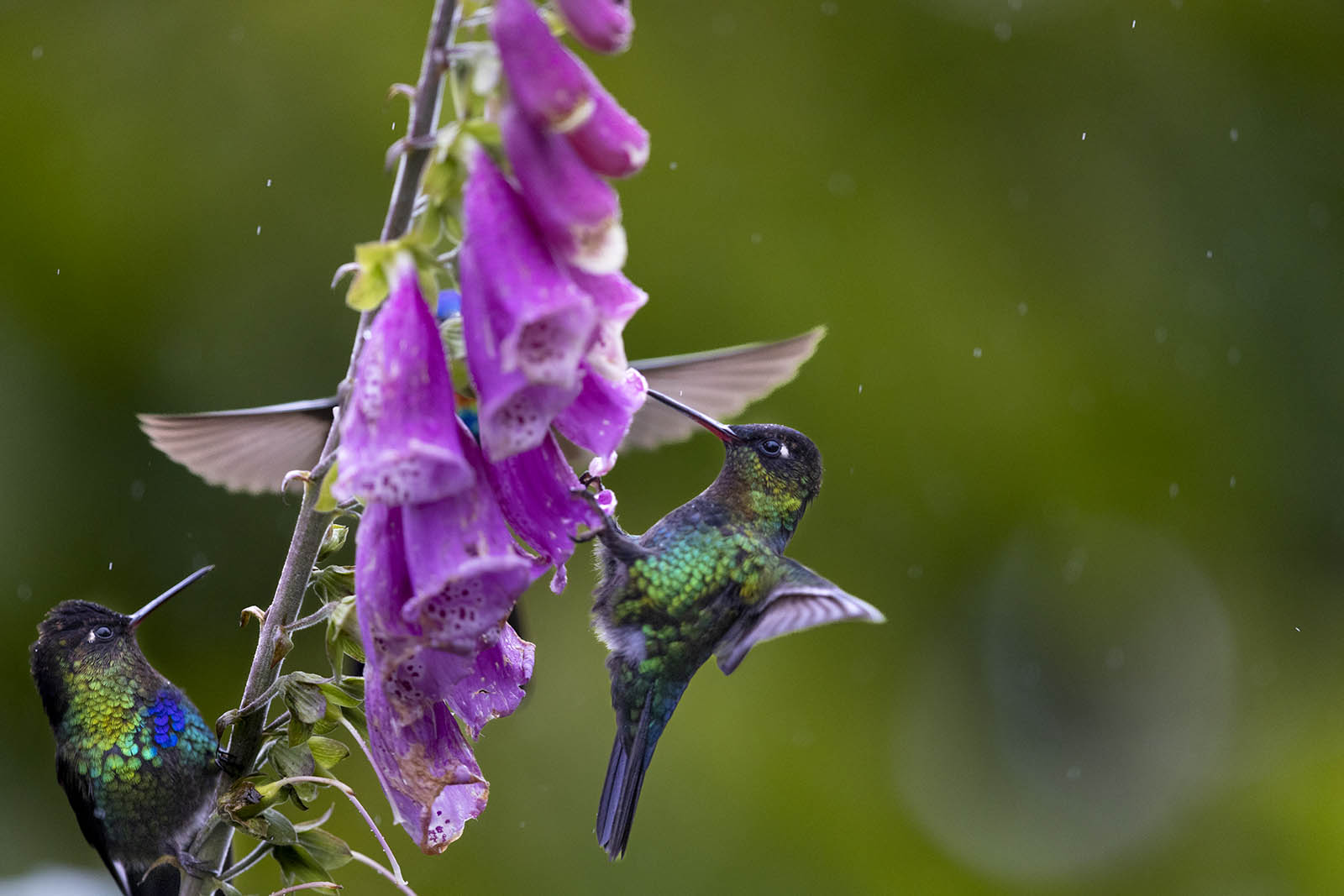 Always feeding,
always jostling
for feeding positions, one wonders how some hummingbirds manage to fly hundreds of miles
without stopping.
Always feeding,
always jostling
for feeding positions, one wonders how some hummingbirds manage to fly hundreds of miles
without stopping.
Ford v. Fiery-Throat
I recently watched the excellent movie 'Ford v. Ferrari' for the third time with the family and it was as throughly enjoyable as watching it the first time. The epic fight between two cars, companies and legacies made colorful by the personalities of the people who built and raced these cars. As I started putting my thoughts for this photo story, I went on a tangent on the geeky end and started reading papers on hummingbird flight mechanics and decided to compare the two disparate fiery creatures : one an engineering marvel and the other being nature's marvel.
 Focused
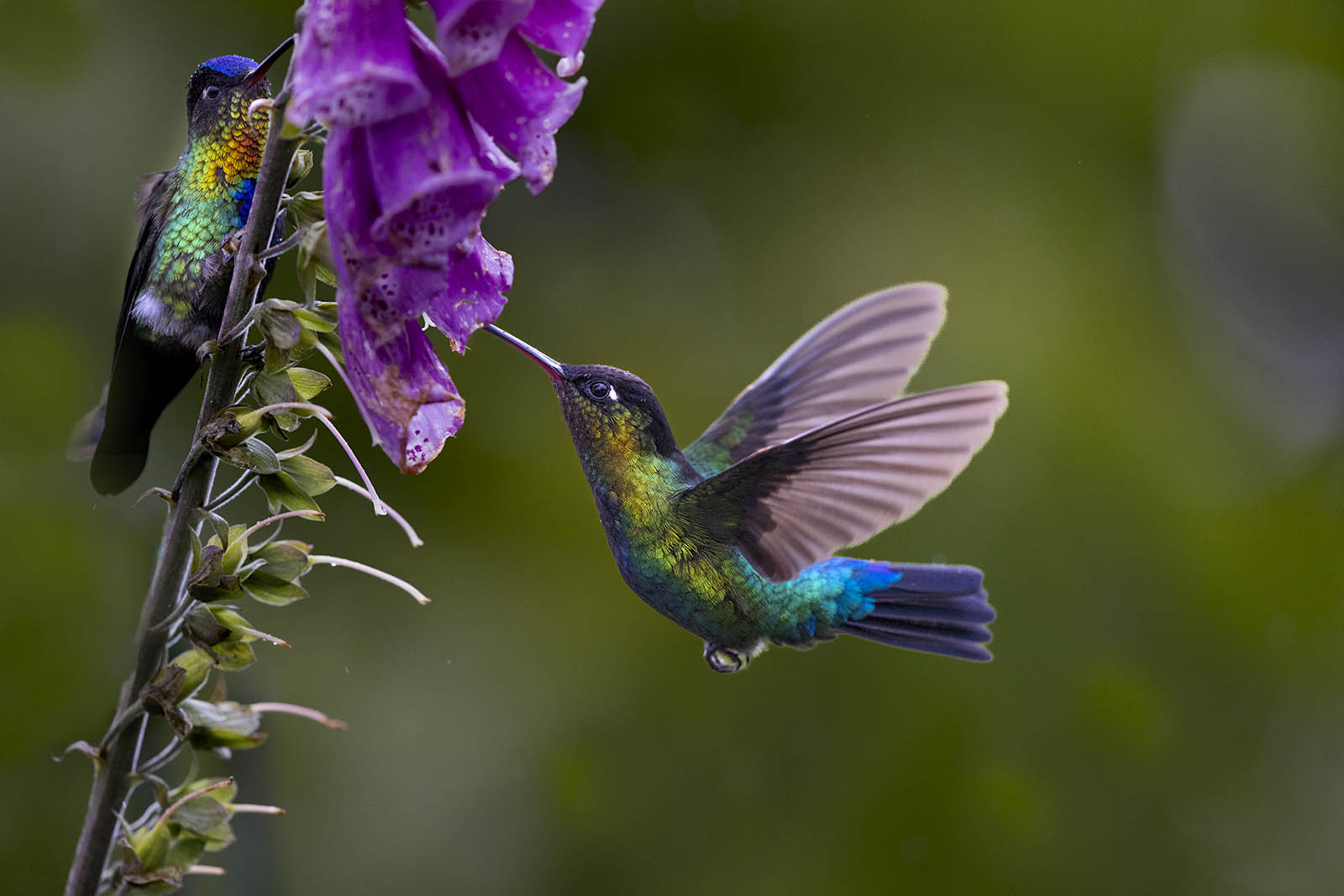
on high-octane flower fuel, is the Fiery-Throated hummingbird aware how it lights up the
garden?
Focused
on high-octane flower fuel, is the Fiery-Throated hummingbird aware how it lights up the
garden?
On a weight basis, the Ford GT40 likely packs more of a punch, achieving speeds no hummingbird can come close to. But is it a fair comparison when the high-octane fuel used by a GT40 is so much more energy dense than sugar water?
| Feature | 1966 Ford GT40 Mark II | Fiery-Throated Hummingbird |
|---|---|---|
| Weight | ~2,500 lbs (1,134 kg) | ~0.2 oz (5.7 g) |
| Top Speed | ~215 mph (346 km/h) | ~30 mph (48 km/h) in level flight |
A first glance at two very different fiery beasts.
So how about this thought experiment: What if the Ford GT40 had to run on the same fuel as the hummingbird? How much nectar would its engine consume to thunder down the Mulsanne Straight, and, more importantly, how colossal would its "nectar tank" need to be just to finish a single lap?
Take the following comparisons with a grain of salt. It's a fun thought experiment for me and if you'd like to suggest tweaks or point or errors, don't hesitate to reach out to me.
Let's break it down. High-octane racing gasoline is an incredibly energy-dense fuel, packing about 35,000 kilojoules (kJ) of energy per liter. Hummingbird nectar, a roughly 25% sugar solution, is far more modest, containing only about 4600 kJ of energy per liter, or about a ratio of ~7.4:1. The standard fuel tank on a GT40 held about 140 liters. To substitute the fuel with sugar water, you would need a tank nearly seven times larger, a massive, sloshing container that would completely alter the car's weight, balance, and aerodynamics. No longer a car but a sugar truck.
So let's leave the requirements of distance out of this comparison and just look at the 'fuel' consumption to travel a mile at the hummingbird's speed (~30mph)
| Feature | 1966 Ford GT40 Mark II | Fiery-Throated Hummingbird |
|---|---|---|
| Assumed Speed (mph / km/h) | 30 (48) | 30 (48) |
| Energy consumed per mile (in Joules) | 35,000,000 | 2.5 |
| Fuel Energy Density (kJ/litre) | ~35,000 (racing gasoline) | ~4,600 (nectar) |
| Nectar consumed per mile (litres) | ~7.6 | 0.00000054 |
| Relative Fuel Consumption (Total Joules / mile) | 14,000,000 | 1 |
| Relative Fuel Consumption adjusted for Weight (Total Joules / mile / kg) | 31,818 | 455 |
Hummingbird metabolism is in a league of its own.
The fiery-throat hummingbird is in its own universe when it comes to 'fuel' efficiency. So how to make sense of these back-of-the-napkin comparisons?
The answer lies in the fundamental difference between a machine and a living creature. The GT40 is machine designed to hold a driver and withstand the rigors of the 24-hour Le Mans. The engine moves the car, but the chassis, the wheels, the seat, the driver — they just go along for the ride. The hummingbird is different. Every single one of its 5 grams is a living, working machine. Every gram has a metabolic cost. Every gram is working to pump blood, move muscle, process oxygen, maintain a core temperature of 104°F, and beat its wings 50 times a second just to counteract gravity.
The car optimizes for friction and air resistance while withstanding a punishing amount of wear and tear; the hummingbird optimizes for survival.
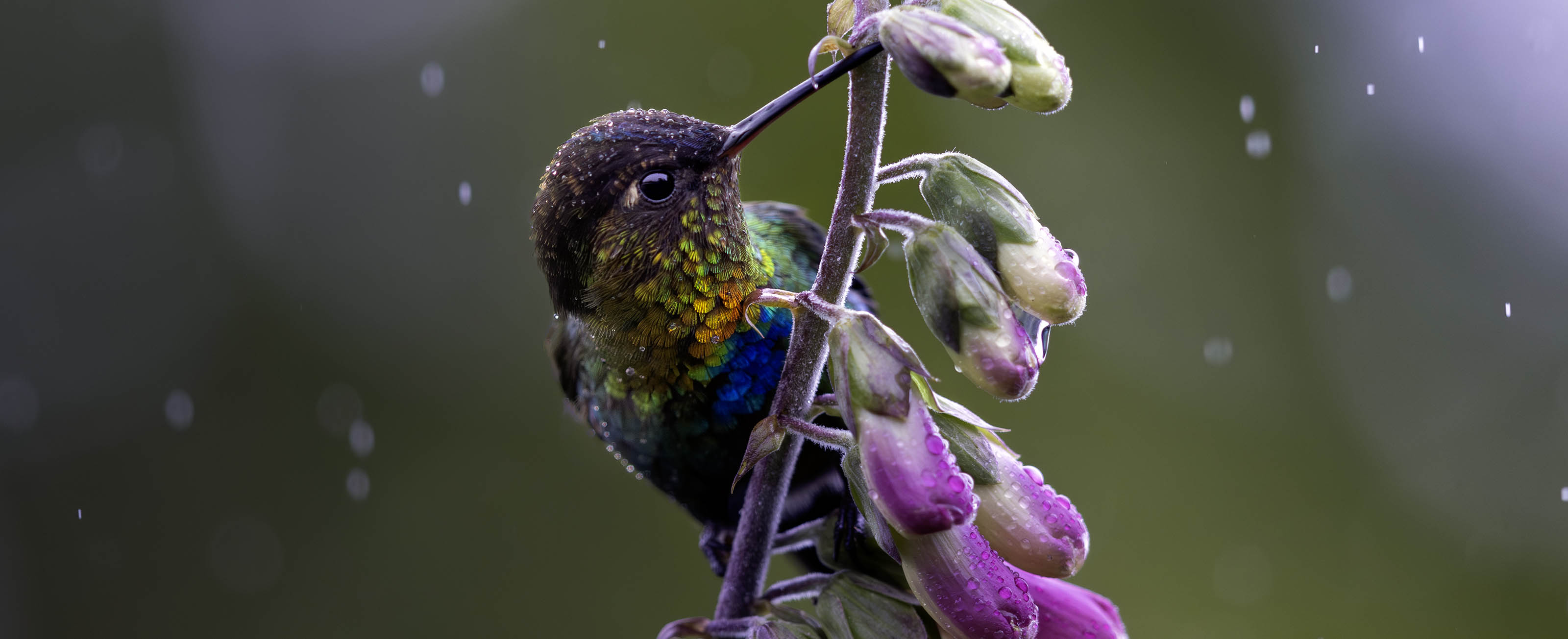
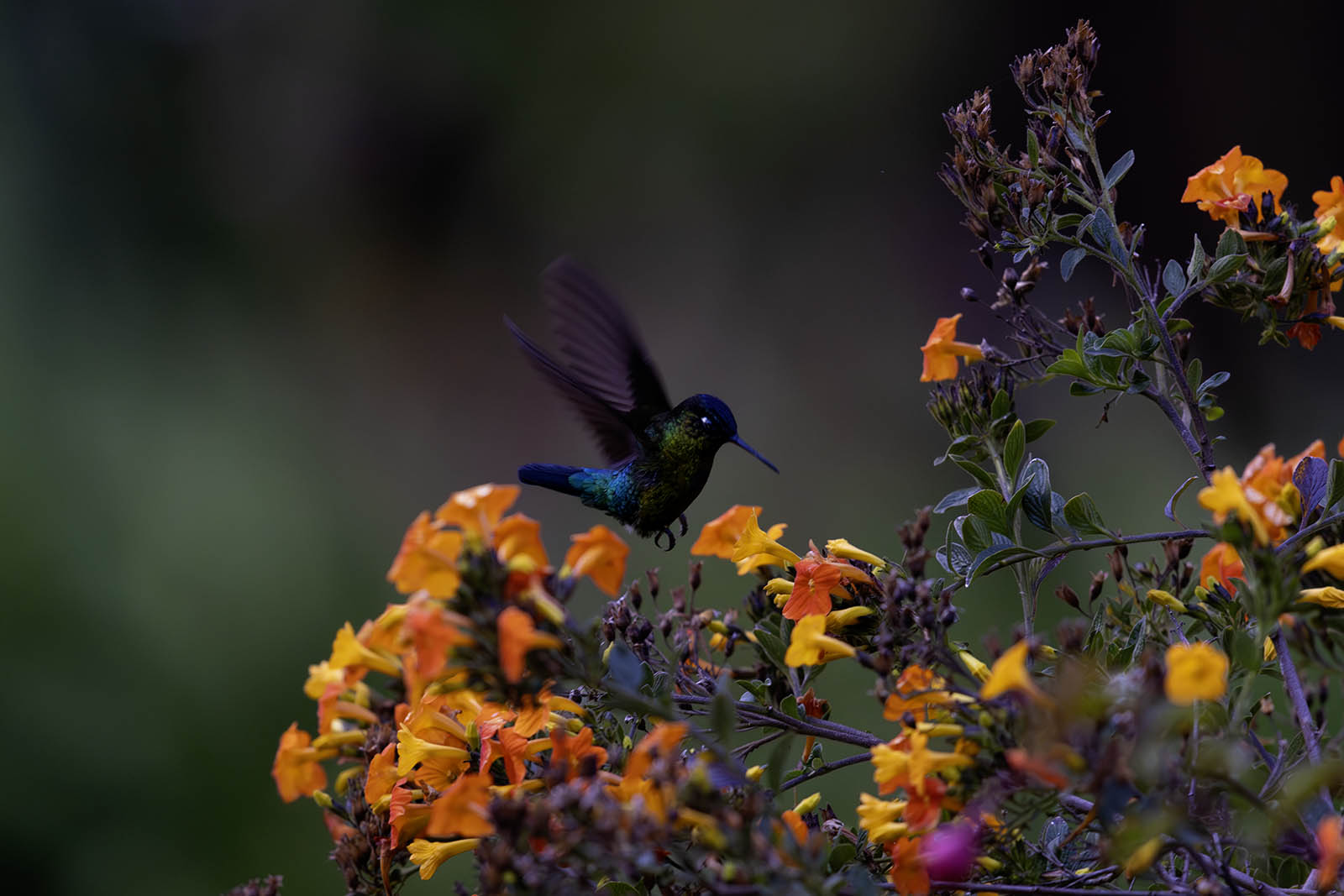 Hummingbirds
and flowers, a photographic juxtaposition that never gets old.
Hummingbirds
and flowers, a photographic juxtaposition that never gets old.
Meditations
The Bar-tailed Godwit's migratory route—a single, direct trans-Pacific line—was only confirmed with the advent of miniaturized satellite tracking technology in the early 2000s. For millennia, this champion flyer has just been doing its thing and its incredible feat remained hidden. With the Barwit's secret only recently unveiled and you wonder how little we truly know about the full range of life on our planet.
It compels us to consider that countless other equally astonishing physiological, behavioral, and navigational wonders likely exist among the millions of species on Earth, largely unnoticed and unstudied.
So the next time life feels like an unending marathon with task after daunting task to be completed, pause for a moment to consider the Bar-tailed Godwit and the Ruby-Throated Hummingbird - and their migration journey as a powerful metaphor for clearly defined purpose driving extraordinary achievement - a reminder that we, too, carry the capacity to do epic things in life.
Published Sep 23rd, 2025